
Dog Grooming at Home: Why Every Owner Should Learn the Basics
Taking on dog grooming at home might feel intimidating at first, but here’s the truth: with the right tools and a bit of patience, you can handle most of your dog’s grooming needs yourself. Not only will you save hundreds of dollars a year, but you’ll also strengthen the bond between you and your furry companion in a way that no trip to the groomer’s salon can replicate.
This complete guide walks you through everything you need to know — from choosing the right brush for your dog’s coat type to safely trimming nails and cleaning ears. Whether you’ve just brought home your first puppy or you’ve had dogs for years and want to level up your care routine, this guide has you covered.
Why Regular Grooming Matters
Health Benefits You Can’t Ignore
Grooming isn’t just about keeping your dog looking sharp. It’s one of the most effective forms of preventive health care you can provide. Regular brushing removes dead hair, distributes natural oils, and prevents matting that can lead to painful skin infections. When you run your hands over your dog’s body during grooming, you’re also performing an informal health check — catching lumps, bumps, parasites, or skin irritations early, before they become serious problems.
Neglected nails can cause joint pain and altered gait. Dirty ears become breeding grounds for bacteria and yeast. Plaque buildup on teeth leads to periodontal disease, which can affect your dog’s heart, kidneys, and liver. Grooming addresses all of these issues before they escalate into expensive vet visits.
The Bonding Factor
Dogs are social creatures, and grooming mimics the mutual care behaviours they’d engage in naturally. When you groom your dog calmly and consistently, you build trust. Over time, most dogs actually look forward to grooming sessions because they associate them with your undivided attention and gentle touch. Starting dog grooming at home when your pet is young creates a lifetime of positive associations with being handled — which also makes vet visits much less stressful for everyone involved.
Essential Grooming Tools Checklist
Before you start your first session, gather these essentials. Investing in quality tools upfront makes the experience better for both you and your dog.
- Slicker brush — The all-rounder. Works well on most coat types, especially medium and long coats. Removes tangles and loose fur effectively.
- Bristle brush — Ideal for short-coated breeds. Distributes natural oils and adds shine without irritating the skin.
- Undercoat rake or deshedding tool — Essential for double-coated breeds like Huskies, Golden Retrievers, and German Shepherds. Reaches the dense undercoat without damaging the topcoat.
- Steel comb — Useful for finishing work, checking for remaining tangles, and grooming facial hair on bearded breeds.
- Nail clippers or grinder — Choose guillotine-style clippers for small dogs or plier-style for larger breeds. Rotary grinders are a great low-stress alternative.
- Dog-specific shampoo and conditioner — Never use human products. Dogs have a different skin pH (around 6.5–7.5 compared to human skin at 4.5–5.5), and human shampoo will dry out their skin.
- Ear cleaning solution — A veterinarian-approved ear cleaner formulated specifically for dogs.
- Dog toothbrush and toothpaste — Use enzymatic toothpaste made for dogs. Human toothpaste contains xylitol and fluoride, both of which are toxic to dogs.
- Grooming table or non-slip mat — A non-slip surface is crucial for your dog’s safety and confidence during grooming.
- Styptic powder — Stops bleeding quickly if you accidentally cut a nail too short. Keep this within arm’s reach during every nail trim.
- Treats — Positive reinforcement is your best friend during dog grooming at home. Reward calm behaviour generously.
Step-by-Step Coat Brushing by Coat Type
Not all coats are created equal, and using the wrong technique or tool can do more harm than good. Here’s how to approach each coat type.
Short Coat (Beagles, Boxers, Dachshunds)
Short-coated dogs are the easiest to groom, but they still shed — sometimes heavily. Use a bristle brush or rubber curry brush in circular motions to loosen dead hair and stimulate the skin. Follow up by brushing in the direction of hair growth to smooth the coat. Once a week is usually sufficient, though you may want to brush more frequently during shedding season in spring and autumn.
Medium Coat (Border Collies, Cocker Spaniels, Australian Shepherds)
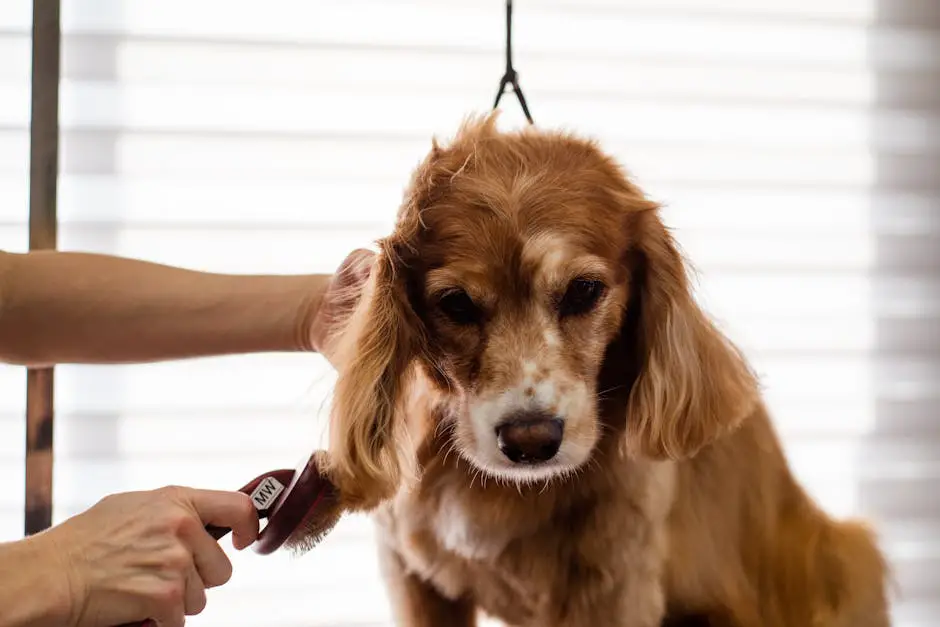
Medium coats tend to develop tangles behind the ears, under the legs, and around the collar area. Start with a slicker brush to work through any knots, then follow with a bristle brush for a smooth finish. Pay special attention to feathering on the legs and belly. Brush two to three times per week to prevent mats from forming.
Long Coat (Shih Tzus, Maltese, Yorkshire Terriers, Afghan Hounds)
Long-coated breeds require daily brushing to prevent painful matting. Work in sections, starting from the ends of the hair and gradually working toward the skin — never drag the brush from root to tip through a tangle. Use a slicker brush first, then a steel comb to check for any remaining knots. A light detangling spray can make the process smoother. If you find a mat that’s too tight to brush out, carefully cut it away with blunt-tipped scissors rather than pulling at it.
Double Coat (Huskies, Golden Retrievers, German Shepherds, Corgis)
Double-coated breeds have a dense, insulating undercoat beneath a longer topcoat. These dogs go through dramatic seasonal “blowouts” where they shed their undercoat en masse. Use an undercoat rake or deshedding tool to remove loose undercoat without cutting the topcoat. Brush at least two to three times per week year-round, and daily during shedding season. Never shave a double-coated dog — their undercoat actually helps regulate body temperature in both hot and cold weather, and it may not grow back properly.
Wire or Rough Coat (Wire Fox Terriers, Schnauzers, Border Terriers)
Wiry coats need a different approach. Use a slicker brush to remove loose hair, then a stripping knife or stripping stone to hand-strip dead hairs from the outer coat. Hand-stripping maintains the coat’s characteristic rough texture and vibrant colour. If you choose to clip instead, be aware that the coat will gradually become softer and may lose its distinctive look. Brush two to three times per week and hand-strip every few months.
Bathing Your Dog: The Complete Guide
How Often Should You Bathe Your Dog?
Most dogs do well with a bath every four to six weeks, but this varies significantly by breed, activity level, and coat type. Dogs with oily coats (like Basset Hounds) may need bathing more frequently, while breeds with water-repellent coats (like Golden Retrievers) should be bathed less often to preserve their coat’s natural properties. Hairless breeds need weekly baths. If your dog rolls in something foul, that’s obviously an immediate bath regardless of schedule.
Water Temperature and Preparation
Use lukewarm water — roughly body temperature, around 37°C (98°F). Water that’s too hot can burn your dog’s skin, and cold water is uncomfortable and can cause stress. Before getting your dog wet, brush out all tangles and mats. Wet mats tighten dramatically and become nearly impossible to remove without cutting.
Step-by-Step Bathing Technique
- Place a non-slip mat in your tub, shower, or basin. A scared, slipping dog will never enjoy bath time.
- Wet your dog thoroughly from the neck down using a handheld sprayer or cup. Avoid spraying directly into the face and ears.
- Apply dog shampoo starting at the neck and working backwards. Massage it into the coat in the direction of hair growth, reaching down to the skin.
- Rinse completely. This is the most important step. Shampoo residue causes itching, flaking, and irritation. Rinse until the water runs completely clear, then rinse one more time for good measure.
- Apply conditioner if your dog has a long or dry coat. Leave it on for the recommended time, then rinse thoroughly.
- Gently wash the face with a damp cloth — no shampoo near the eyes.
- Towel dry by pressing and squeezing the coat rather than vigorous rubbing, which causes tangles. Use a blow dryer on a cool or low-heat setting if your dog tolerates it, keeping it moving to avoid concentrating heat in one spot.
Nail Trimming: A Step-by-Step Guide with Safety Tips
Nail trimming is the grooming task that makes most owners nervous, and that anxiety often transfers to the dog. The good news: with practice, dog grooming at home nail trims become routine for both of you.
Understanding the Quick
Inside each nail is a blood vessel and nerve called the quick. On light-coloured nails, you can see it as the pinkish area inside the nail. On dark nails, you’ll need to trim gradually and watch for a chalky white ring appearing on the cut surface — stop trimming when you see a darker centre beginning to appear. This indicates you’re approaching the quick.
Trimming Technique
- Hold your dog’s paw firmly but gently. Don’t squeeze the toes.
- Position the clipper at a 45-degree angle, just below where the nail starts to curve downward.
- Make small, conservative cuts rather than one large cut. It’s always better to take too little than too much.
- Trim the dewclaws if your dog has them — these don’t wear down naturally and can grow into the pad if neglected.
- Smooth rough edges with a nail file or grinder.
What to Do If You Cut the Quick
Don’t panic. It happens to everyone, including professional groomers. Apply styptic powder or cornstarch directly to the bleeding nail and apply firm pressure for 30 seconds. The bleeding should stop within a few minutes. Give your dog a treat and some reassurance. If bleeding doesn’t stop within 10 minutes, contact your vet.
The Grinder Alternative
If clippers make you or your dog anxious, try a rotary nail grinder. These tools gradually file the nail down, giving you more control and virtually eliminating the risk of cutting the quick. Introduce the grinder slowly — let your dog hear and smell it before touching it to their nails.
Ear Cleaning Basics
Signs of Ear Problems
Watch for these warning signs: redness, swelling, discharge, foul odour, excessive scratching, or head shaking. Dogs with floppy ears (Basset Hounds, Cocker Spaniels, Labrador Retrievers) are particularly prone to ear infections because the ear flap traps moisture and reduces airflow.
How to Clean Your Dog’s Ears
- Lift the ear flap to expose the ear canal.
- Squeeze a veterinarian-approved ear cleaning solution into the ear canal until you can see the liquid.
- Gently massage the base of the ear for 20 to 30 seconds. You should hear a satisfying squishing sound.
- Let your dog shake their head — this brings debris up from deep in the canal.
- Wipe away loosened debris and excess solution with a cotton ball or gauze pad.
- Never insert cotton buds or anything rigid into the ear canal. You can push debris deeper and risk damaging the eardrum.
Clean ears every two to four weeks for most dogs, or weekly for breeds prone to ear infections. If you notice persistent odour, discharge, or inflammation, see your vet — these could indicate an infection that needs medication.
Teeth Brushing for Dogs
Why Dental Care Matters
By age three, over 80% of dogs show signs of periodontal disease. Bacteria from dental infections can enter the bloodstream and damage the heart, liver, and kidneys. Regular teeth brushing is one of the most impactful things you can do for your dog’s long-term health when dog grooming at home.
How to Brush Your Dog’s Teeth
- Start slowly. Let your dog taste the enzymatic toothpaste (most dogs love the poultry or beef flavours). Rub a small amount on their gums with your finger for a few days before introducing the brush.
- Use a dog-specific toothbrush or finger brush. Angle the bristles at 45 degrees to the gum line.
- Focus on the outer surfaces of the teeth, particularly the upper back molars where plaque accumulates most.
- Use gentle, circular motions. You don’t need to scrub hard — the enzymatic action of the toothpaste does much of the work.
- Aim for two minutes total, but even 30 seconds is better than nothing.
How Often and Alternatives
Daily brushing is ideal, but three to four times per week still provides significant benefit. If your dog absolutely refuses a toothbrush, dental chews, water additives, and dental wipes offer some protection — though none is as effective as brushing. Schedule a professional dental cleaning with your vet every one to two years.
Grooming Schedule by Breed Type
Use this table as a starting point for planning your dog grooming at home routine. Adjust based on your individual dog’s needs, activity level, and coat condition.
| Coat Type | Brushing Frequency | Bathing Frequency | Professional Grooming |
|---|---|---|---|
| Short coat (Beagle, Boxer, Dalmatian) | Once per week | Every 6–8 weeks | Optional; 2–3 times per year |
| Medium coat (Border Collie, Australian Shepherd) | 2–3 times per week | Every 4–6 weeks | Every 6–8 weeks |
| Long coat (Shih Tzu, Maltese, Yorkshire Terrier) | Daily | Every 3–4 weeks | Every 4–6 weeks |
| Double coat (Husky, Golden Retriever, Corgi) | 2–3 times per week; daily during shedding | Every 6–8 weeks | Seasonally; 3–4 times per year |
| Wire/rough coat (Schnauzer, Wire Fox Terrier) | 2–3 times per week | Every 4–6 weeks | Every 6–8 weeks (hand-stripping) |
| Curly coat (Poodle, Bichon Frise, Lagotto) | Daily to every other day | Every 3–4 weeks | Every 4–6 weeks |
| Hairless (Chinese Crested, Xoloitzcuintli) | N/A | Weekly | Rarely needed |
Common Grooming Mistakes to Avoid
Even well-intentioned owners make these errors. Avoiding them will make your dog grooming at home sessions safer and more enjoyable.
- Bathing before brushing. Wet mats and tangles tighten dramatically and can only be removed by cutting. Always brush your dog thoroughly before getting them wet.
- Using human shampoo or products. Dogs have a different skin pH than humans. Human products strip natural oils and can cause dryness, irritation, and allergic reactions.
- Neglecting to rinse thoroughly. Leftover shampoo residue causes itching, flaking, and hot spots. Rinse until the water runs crystal clear, then rinse again.
- Cutting nails too aggressively. Taking too much off in one cut risks hitting the quick and creating a negative association with nail trims. Small, frequent trims are far better than infrequent drastic cuts.
- Shaving double-coated breeds. Their undercoat provides insulation against both heat and cold. Shaving damages the coat structure, and it often grows back patchy or with an altered texture.
- Forcing a stressed dog through grooming. If your dog is panicking, stop. Forcing the issue creates lasting negative associations. Break sessions into shorter segments and pair each step with treats and praise.
- Ignoring the ears and teeth. These are the most commonly skipped areas, yet they’re where some of the most serious health problems develop. Make them a non-negotiable part of your routine.
- Using dull tools. Dull clippers pull and tug rather than cut cleanly, causing discomfort and a ragged finish. Replace clipper blades regularly and keep scissors sharp.
When to See a Professional Groomer
While dog grooming at home handles most maintenance, certain situations call for professional expertise. Don’t hesitate to book a professional groomer when:
- Severe matting has developed close to the skin. Attempting to brush or cut out severe mats yourself can cause skin tears and significant pain.
- Your dog needs a breed-specific haircut (Poodle clips, Schnauzer patterns, Bichon styles) that requires professional training and equipment.
- Your dog has skin conditions that require medicated baths or specialised treatment — your vet or a veterinary-trained groomer can handle these safely.
- You’re dealing with a fearful or aggressive dog that poses a safety risk during home grooming. Professional groomers have experience managing difficult temperaments and appropriate restraint techniques.
- Anal gland expression is needed. While some groomers offer this service, it’s often best handled by your vet, especially if the glands are impacted or infected.
- Hand-stripping is required for wire-coated breeds and you’re not confident in the technique. Improper stripping can damage the coat.
A good approach is to establish a relationship with a professional groomer even if you handle most grooming yourself. They can take care of the more technical tasks a few times a year while you maintain your dog’s coat, nails, ears, and teeth in between visits.
Frequently Asked Questions About Dog Grooming at Home
How do I get my dog to stay calm during grooming?
Start with very short sessions — even just 30 seconds of brushing followed by a treat. Gradually increase the duration as your dog builds positive associations. Choose a time when your dog is naturally calm, such as after a walk or play session. Use a calm, reassuring voice throughout, and never punish your dog for being nervous. If your dog is particularly anxious, try pairing grooming with a lick mat spread with peanut butter (xylitol-free) to create a positive distraction. Consistency is key — regular, brief sessions build confidence much faster than occasional marathon grooming attempts.
What age should I start grooming my puppy?
Begin handling and gentle grooming exercises as early as seven to eight weeks old. The critical socialisation window closes around 14 to 16 weeks, so the earlier you introduce your puppy to brushing, nail handling, ear touching, and mouth inspection, the more accepting they’ll be as adults. Keep puppy grooming sessions very short (two to three minutes), focused on positive exposure rather than thoroughness. Introduce tools gradually — let them sniff the brush, hear the clippers, and feel the water before using them properly. Every dog grooming at home session at this age should end with praise and a treat.
Can I use a human hair dryer on my dog?
You can, but with caution. Use the cool or lowest heat setting only and keep the dryer moving constantly to avoid concentrating heat on one area. Hold it at least 15 centimetres away from your dog’s skin. Human dryers can get dangerously hot for dog skin, which is thinner and more sensitive than ours. If you groom frequently, consider investing in a purpose-built dog dryer or high-velocity dryer — they’re designed to move water out of the coat efficiently without excessive heat and dry a dog significantly faster than a household hair dryer.
How do I know if my dog’s nails are too long?
The simplest test: when your dog stands on a flat, hard surface, their nails should not touch the ground. If you can hear clicking when they walk on tile or hardwood, the nails are overdue for a trim. Excessively long nails force your dog to shift their weight backward, which can lead to joint pain, altered gait, and long-term musculoskeletal problems. If the nails have grown very long, the quick extends with them, so you’ll need to trim small amounts every week to encourage the quick to recede before you can reach the ideal length.
Is it safe to groom my dog outside?
Grooming outside can be a great option, especially for bathing large dogs and brushing out heavy shedders — you’ll save yourself a lot of indoor cleanup. However, keep a few things in mind: avoid grooming in direct, hot sun as both you and your dog will overheat; make sure the area is secure so your dog can’t bolt if startled; use warm water from a hose attachment rather than cold water straight from the tap; and be aware that loose fur from brushing can blow around the garden. In cooler months, groom inside where you can control the temperature. Whatever you choose, a non-slip surface remains essential for your dog’s safety and comfort during dog grooming at home sessions.
Featured Image Source: Pexels