
Why Training Your Dog Matters More Than You Think
After fifteen years of working with dogs of every breed, size, and temperament, I can tell you this with absolute certainty: training isn’t about making your dog obey. It’s about building a language between you and your best friend. When you train your dog, you’re giving them the tools to understand what you want, and that understanding creates trust, confidence, and a bond that lasts a lifetime.
Training matters for three critical reasons that every dog owner should understand:
- Bonding: Every training session is quality time spent together. Your dog learns to look to you for guidance, and you learn to read their body language and responses. This mutual understanding deepens your relationship in ways that simply coexisting in the same house never will.
- Safety: A reliable recall command can save your dog’s life if they slip their leash near a busy road. A solid “leave it” can prevent them from eating something toxic. Training isn’t optional — it’s a safety net you hope you never need but will be grateful you built.
- Mental stimulation: Dogs need mental exercise just as much as physical exercise. A fifteen-minute training session can tire your dog out more effectively than an hour-long walk. Bored dogs chew furniture, bark excessively, and develop anxiety. Trained dogs are calmer, happier, and more confident.
Before You Start: Setting Yourself Up for Success
Before you teach a single command, you need to understand the fundamentals that make training work. Skip these, and you’ll spend weeks wondering why your dog isn’t learning. Get them right, and you’ll be amazed at how quickly your dog picks things up.
Choose High-Value Treats
Your dog’s regular kibble won’t cut it for training. You need something special — small, soft treats that your dog can eat quickly without stopping to chew. Think pea-sized pieces of cooked chicken, cheese, or commercial training treats. The treat should be exciting enough that your dog is willing to work for it. If they seem uninterested, upgrade to something more enticing.
Master Your Timing
You have approximately one to two seconds to reward your dog after they perform the desired behaviour. Miss that window, and your dog won’t connect the action with the reward. This is why many trainers use a clicker or a marker word like “yes” — it bridges the gap between the moment your dog does the right thing and the moment the treat reaches their mouth.
Be Consistent
If “down” means lie on the floor, it always means lie on the floor. Don’t use “down” one day and “lie down” the next. Make sure everyone in your household uses the same words and the same rules. Inconsistency is the number one reason dogs seem stubborn — they aren’t being defiant, they’re genuinely confused.
Keep Sessions Short
Five to ten minutes is plenty for a single training session. You can do multiple sessions throughout the day, but each one should be short and end on a positive note. If you or your dog are getting frustrated, stop. Take a break and try again later. Training should be fun for both of you.
10 Essential Commands Every Dog Should Know
1. Sit
Why it matters: Sit is the foundation of everything else. It’s the easiest command to teach, which makes it perfect for building your dog’s confidence and your training skills. A dog that sits on cue is a dog that has learned to check in with you before acting, and that principle carries through to every other command.
How to teach it:
- Hold a treat close to your dog’s nose so they can smell it but not grab it.
- Slowly move the treat upward and slightly back over their head. As their nose follows the treat, their bottom will naturally lower to the ground.
- The instant their bottom touches the floor, say “yes” and give them the treat.
- Repeat this five to six times, then add the verbal cue “sit” just before you lure them into position.
- Gradually phase out the hand lure so your dog responds to the verbal cue alone.
Common mistakes: Pushing your dog’s bottom down physically. This creates resistance rather than understanding. Also, repeating the word “sit” over and over — say it once and wait. If your dog doesn’t respond, reset and try again with the lure.
2. Stay
Why it matters: Stay teaches your dog impulse control and patience. It’s essential for keeping your dog safe in situations where movement could be dangerous, like an open front door or a busy car park. A reliable stay also makes everyday life significantly easier, from vet visits to greeting guests.
How to teach it:
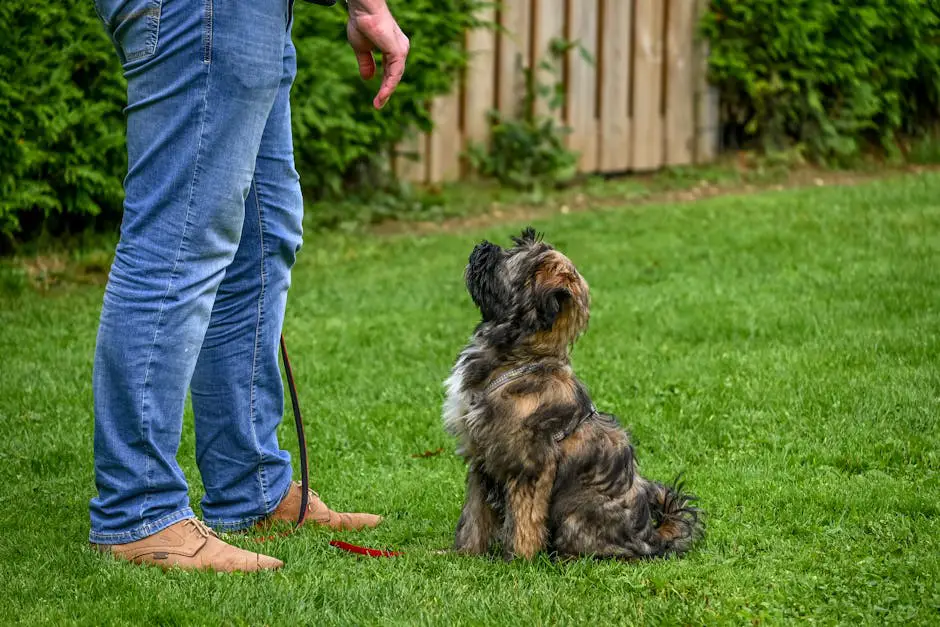
- Ask your dog to sit. Hold your open palm toward them like a stop signal and say “stay.”
- Wait one second, then reward. Your dog doesn’t need to stay for a long time at first — one second of success is better than ten seconds of failure.
- Gradually increase the duration by one to two seconds at a time. Only increase when your dog succeeds at the current level consistently.
- Once your dog can stay for fifteen to twenty seconds, begin adding distance. Take one small step back, return, and reward.
- Build distance and duration separately, then combine them. Add distractions only after both are solid.
Common mistakes: Moving too fast. If your dog breaks the stay, you’ve asked for too much too soon. Go back to the last level they succeeded at and build from there. Never call your dog out of a stay and then scold them for coming — that punishes the recall, not the broken stay.
3. Come (Recall)
Why it matters: This is the command that can save your dog’s life. A reliable recall means you can let your dog enjoy off-lead time with confidence, and you can get them back to safety in an emergency. I consider this the single most important command you will ever teach.
How to teach it:
- Start indoors with minimal distractions. Get your dog’s attention, say their name followed by “come,” and take a few steps backward while making yourself exciting — crouch down, use a happy voice, open your arms.
- When your dog reaches you, reward generously. Not one treat — a whole handful. Coming to you should feel like winning the lottery.
- Practice in your garden, then in a quiet park on a long line. Never practise off-lead recall in an unfenced area until it’s rock solid.
- Make coming to you the best thing that ever happens. Never call your dog to you for something unpleasant like a bath or leaving the park. Go and get them instead.
- Practise recall games like “ping pong” with another person — take turns calling the dog back and forth, rewarding each time.
Common mistakes: Calling your dog to you and then putting them on the lead every time. Your dog will learn that “come” means the fun is over. Call them, reward them, and let them go play again most of the time. Also, never chase a dog that won’t come — run away from them instead and let their instinct to follow kick in.
4. Down
Why it matters: Down is a calming position. A dog that can lie down on cue is a dog you can take to restaurants, offices, and friends’ houses. It’s also useful for settling an over-excited dog and for veterinary examinations. Down is a natural progression from sit and builds further impulse control.
How to teach it:
- Start with your dog in a sit. Hold a treat at their nose, then slowly lower it straight down to the floor between their front paws.
- As their nose follows the treat downward, their body should fold into a down position. The moment their elbows touch the floor, say “yes” and reward.
- If your dog stands up instead of lying down, try luring the treat slightly toward you as you lower it, creating an L-shaped motion.
- Once your dog follows the lure reliably, add the verbal cue “down” just before the hand motion.
- Gradually reduce the lure until your dog responds to the word alone.
Common mistakes: Trying to physically push your dog into a down. This often triggers resistance because lying down is a vulnerable position for dogs. Let them choose to do it, and they’ll be much more comfortable with the command. Also, avoid practising on cold, wet, or hard surfaces — your dog is less willing to lie down when it’s uncomfortable.
5. Leave It
Why it matters: Leave it tells your dog to ignore something tempting — food on the pavement, a dead bird, another dog’s toy, or anything else they shouldn’t have. This command prevents poisoning, conflicts with other animals, and the destruction of your favourite shoes. It’s a lifesaver, literally.
How to teach it:
- Hold a treat in your closed fist and present it to your dog. They’ll sniff, lick, and paw at your hand. Wait patiently.
- The moment your dog pulls away or looks up at you, say “yes” and give them a different treat from your other hand. Never give them the item you asked them to leave.
- Repeat until your dog consistently backs away from your closed fist. Then add the cue “leave it” as you present your hand.
- Progress to an open palm, then a treat on the floor covered by your hand, then a treat on the floor uncovered.
- Practise with increasingly tempting items and in various environments.
Common mistakes: Letting your dog eventually have the item you asked them to leave. The rule is simple — “leave it” means forever. They always get rewarded with something else instead. This teaches your dog that ignoring temptation pays off better than grabbing it.
6. Drop It
Why it matters: While “leave it” prevents your dog from picking something up, “drop it” gets them to release something already in their mouth. This is critical for safety when your dog grabs something dangerous, and it’s equally useful for games of fetch or when they’ve stolen your sock.
How to teach it:
- Give your dog a toy they enjoy but aren’t obsessed with. Let them hold it for a moment.
- Hold a high-value treat near their nose. Most dogs will drop the toy to take the treat. The instant they release the toy, say “yes” and give the treat.
- Add the verbal cue “drop it” just before presenting the treat.
- Gradually delay showing the treat so your dog learns to drop on the verbal cue alone, trusting that the reward is coming.
- Practise with progressively more valuable items. Always trade up — what you offer should be better than what they have.
Common mistakes: Chasing your dog to get something out of their mouth. This turns it into a game of keep-away and teaches your dog that having something valuable means you’ll chase them — which is incredibly fun for them and incredibly frustrating for you. Stay calm, offer a trade, and reward the release.
7. Heel
Why it matters: Heel means your dog walks calmly beside you without pulling. This makes walks enjoyable rather than a battle of strength. It’s particularly important for safety on busy streets, when passing other dogs, and for owners with smaller builds handling larger breeds.
How to teach it:
- With your dog on your left side, hold a treat in your left hand at your hip. Say “heel” and take a few steps forward.
- If your dog walks beside you, reward every two to three steps. Keep the rate of reinforcement very high at first.
- If your dog pulls ahead, stop walking immediately. Stand still and wait. When they look back at you or return to your side, reward and continue.
- Practise in low-distraction environments first. Your garden or a quiet side street is perfect.
- Gradually increase the number of steps between treats and add turns, stops, and changes of pace.
Common mistakes: Expecting your dog to heel for an entire walk from day one. Heel is a focused behaviour — use it for specific moments like crossing roads or passing distractions. Allow your dog to sniff and explore on a loose lead the rest of the time. Also, jerking the lead doesn’t teach anything except that walks are unpleasant.
8. Wait
Why it matters: Wait is different from stay. Stay means “don’t move until I release you.” Wait means “pause momentarily before continuing.” It’s perfect for doorways, before crossing roads, before eating meals, and before getting out of the car. It builds patience and self-control in everyday situations.
How to teach it:
- At a doorway, ask your dog to sit. Begin to open the door slowly. If your dog moves toward the door, close it (gently).
- Try again. Open the door a small amount. If your dog stays still, say “yes,” give a treat, and then use a release word like “okay” or “free” to let them through.
- Gradually open the door wider before rewarding. Your dog learns that patience opens doors — literally.
- Practise at every doorway, before meals, and before getting in and out of the car.
- Add the verbal cue “wait” once your dog understands the concept.
Common mistakes: Slamming the door or using the door to physically block your dog. The door closing should be a consequence, not a punishment. Close it calmly and try again. Also, make sure you’re using a consistent release word so your dog knows when waiting is over.
9. Off
Why it matters: Off means “get your paws off” — whether that’s off a person, off the furniture, or off the kitchen counter. It’s a polite redirection that teaches your dog where they should be instead. This command is especially important for large breeds whose jumping can knock people over, and for homes where certain areas are off-limits.
How to teach it:
- When your dog jumps on you, turn sideways and avoid eye contact. Don’t push them away — that feels like play to most dogs.
- The moment all four paws are on the ground, say “yes” and reward immediately.
- Add the verbal cue “off” as you turn away from the jumping behaviour.
- Ask guests to follow the same protocol. Consistency from everyone is essential.
- Teach an alternative behaviour, like sitting for greetings. Reward the sit generously so it becomes more rewarding than jumping.
Common mistakes: Using “down” for both “lie down” and “get off.” These should be two separate commands with two separate words. If “down” means both, your dog has no idea which one you want. Also, never knee your dog in the chest — this can cause injury and damages trust.
10. Place
Why it matters: Place means “go to your designated spot and settle there.” This is an incredibly useful real-world command. When guests arrive, when you’re eating dinner, when the delivery person knocks — “place” gives your dog a job to do instead of getting into trouble. It also provides your dog with a sense of security, knowing they have their own space.
How to teach it:
- Choose a specific location — a dog bed, a mat, or a raised cot. This becomes their “place.”
- Lure your dog onto the bed with a treat. The moment they step on it, say “yes” and reward.
- Once they’re stepping on it willingly, add the cue “place” as they move toward the bed.
- Gradually ask for a down on the bed. Reward calm, settled behaviour generously.
- Build duration slowly. Start with a few seconds, work up to several minutes. Use a release word when they’re allowed to leave.
Common mistakes: Using “place” as a punishment. Your dog’s bed should be a positive, rewarding place to be — not somewhere they’re sent when they’ve been naughty. Also, don’t start with long durations. If your dog breaks the place command, you’ve asked for too much too soon.
Positive Reinforcement vs Punishment: The Science Is Clear
I’ve seen a lot of training methods over fifteen years, and I’m not shy about saying this: positive reinforcement works better than punishment. This isn’t just my opinion — it’s backed by decades of behavioural science research.
Positive reinforcement means rewarding the behaviours you want. When your dog sits and gets a treat, they want to sit again. When they come to you and get praise and food, they want to come to you again. You’re building a dog that wants to work with you because good things happen when they do.
Punishment-based methods — prong collars, shock collars, leash corrections, yelling — suppress behaviour through fear and pain. The dog might stop the unwanted behaviour, but they haven’t learned what to do instead. Worse, punishment creates anxiety, damages your relationship, and frequently causes aggression. A dog that’s corrected for growling doesn’t stop feeling uncomfortable — they just stop warning you before they bite.
Here’s what positive reinforcement gives you that punishment never will:
- A confident dog that isn’t afraid to try new things because mistakes don’t hurt
- A trusting relationship where your dog looks to you for guidance rather than avoiding you
- Lasting behaviour change because your dog is motivated by desire, not fear
- Better problem-solving skills because your dog learns to think, not just react
If someone tells you that your dog needs a firmer hand or more discipline, what your dog actually needs is clearer communication, better timing, and higher-value rewards. Every dog I’ve ever worked with has responded to positive reinforcement. Every single one.
Training Schedule: Puppies vs Adult Dogs
Puppy Training Schedule (8 Weeks to 6 Months)
Puppies have short attention spans but learn incredibly quickly. Their brains are wired to absorb information during this critical period.
- Sessions: Three to five sessions per day, two to five minutes each
- Weeks 8-12: Focus on name recognition, sit, and beginning socialisation. Introduce a marker word or clicker. Start house training.
- Weeks 12-16: Add down, come (indoors), and leave it. Continue socialisation with new people, sounds, and environments.
- Weeks 16-24: Introduce stay, wait, and heel on lead. Begin practising commands in new locations with mild distractions.
- Key principle: Keep it fun. Puppies learn through play. If a session isn’t going well, end it with something easy your puppy already knows and try again later.
Adult Dog Training Schedule (6 Months and Older)
Adult dogs can focus for longer periods and often have some existing behaviours to work with — or work around.
- Sessions: Two to three sessions per day, five to ten minutes each
- Weeks 1-2: Establish the basics — sit, down, and name recognition. Build your relationship and learn what motivates your dog.
- Weeks 3-4: Add come, leave it, and drop it. Practise in progressively more distracting environments.
- Weeks 5-8: Introduce stay, wait, heel, off, and place. Focus on real-world application of all commands.
- Key principle: Adult dogs may have learned habits you need to replace. Be patient. It takes longer to change an established behaviour than to teach a new one, but it absolutely can be done.
Best Training Treats and Tools
Training Treats
The right treats make all the difference. Here’s what to look for:
- Soft and small: Pea-sized pieces your dog can swallow quickly. Hard, crunchy treats slow down training because your dog stops to chew.
- High value: Cooked chicken breast, cheese cubes, freeze-dried liver, or hot dog pieces are excellent options. Save these for training only so they remain special.
- Commercial options: Zuke’s Mini Naturals, Wellness Soft Puppy Bites, and Cloud Star Tricky Trainers are popular, convenient choices.
- Portion control: Training treats should make up no more than ten percent of your dog’s daily calorie intake. Reduce their meal portions slightly on heavy training days.
Training Tools
- Treat pouch: A clip-on pouch keeps treats accessible and your hands free. This dramatically improves your timing.
- Clicker or marker word: A clicker produces a consistent, distinct sound that marks the exact moment your dog does the right thing. If you prefer, a short, sharp word like “yes” works similarly.
- Standard flat collar and lead: A six-foot lead gives your dog enough room to make choices while keeping them safe. Avoid retractable leads for training — they teach dogs that pulling extends the leash.
- Long line: A fifteen to thirty-foot training lead is essential for practising recall before your dog is ready for off-lead work.
- Mat or bed: A portable mat for teaching the “place” command. Choose something you can easily take to different locations.
When to Hire a Professional Trainer
There’s absolutely no shame in getting professional help. In fact, a good trainer can save you months of frustration and prevent small problems from becoming serious ones. Consider hiring a professional if:
- Your dog shows aggression — growling, snapping, lunging, or biting toward people or other dogs. Aggression requires expert assessment and a carefully managed behaviour modification plan. Do not attempt to fix this on your own.
- Your dog has severe anxiety — extreme separation anxiety, fear of everyday objects or sounds, or panic in normal situations. These issues often require a combination of training and, in some cases, veterinary support.
- You’ve been trying for several weeks without progress. If your dog isn’t responding to your training efforts, a professional can identify what’s going wrong and adjust the approach. Often it’s a small timing or communication issue that’s easy to fix once you can see it.
- You have a new rescue dog with an unknown history. A professional can help you assess your dog’s temperament, identify potential triggers, and build a training plan tailored to their specific needs.
- You want to get it right from the start. Puppy classes with a qualified trainer are one of the best investments you can make. They provide socialisation, foundational training, and guidance during the most critical learning period of your dog’s life.
When choosing a trainer, look for someone who uses positive reinforcement methods, holds credentials from recognised organisations like the Certification Council for Professional Dog Trainers or the Association of Professional Dog Trainers, and who makes you feel comfortable asking questions. If a trainer suggests methods that involve pain, fear, or intimidation, walk away.
Frequently Asked Questions
How long does it take to train a dog basic commands?
Most dogs can learn individual commands within a few days to two weeks of consistent practice. However, making those commands reliable in different environments with distractions typically takes four to eight weeks. Every dog learns at their own pace, and some commands come more naturally than others depending on the breed and individual temperament. The key is consistent daily practice — even five minutes a day adds up quickly.
Is it too late to train my older dog?
Absolutely not. The saying “you can’t teach an old dog new tricks” is simply wrong. Dogs of any age can learn new behaviours. Older dogs often have better focus and impulse control than puppies, which can actually make them easier to train in some ways. The process may take a bit longer if you’re replacing deeply ingrained habits, but with patience and consistency, senior dogs respond beautifully to positive reinforcement training.
My dog only listens when I have treats. How do I fix this?
This is one of the most common concerns, and the solution is to transition from continuous reinforcement to variable reinforcement. Start by rewarding every correct response. Once the behaviour is reliable, begin rewarding every other time, then every third time, mixing in verbal praise, play, and life rewards like going through a door or getting their lead clipped on for a walk. Your dog should never know exactly when a treat is coming — this unpredictability actually makes the behaviour stronger, not weaker, much like how a slot machine is more compelling than a vending machine.
What should I do if my dog seems scared during training?
Stop immediately and assess what’s causing the fear. Signs of stress in dogs include whale eyes (showing the whites of their eyes), lip licking, yawning, turning away, tucked tail, and cowering. If your dog shows any of these signs, you may be working in an environment that’s too stimulating, using treats that are too close to their face, or inadvertently using a tone of voice that’s intimidating. Lower the difficulty, increase the distance from whatever is causing concern, and make sure training feels safe and rewarding. If the fear persists, consult a professional trainer who specialises in fearful dogs.
Can I train two dogs at the same time?
It’s best to start by training each dog individually. When two dogs train together, they distract each other, compete for treats, and often learn to rely on watching the other dog rather than listening to you. Once each dog has a solid understanding of the commands individually, you can begin practising together in short sessions. Even then, it helps to have a second person present so each dog has a dedicated handler. Training separately first, then combining, produces much better results than trying to teach both dogs simultaneously from the beginning.
Featured Image Source: Pexels