


Let me be honest with you — if you’re reading this at 2 AM with a puppy that sounds like it’s being murdered in its crate, I get it. I’ve been there. My Border Collie, Finn, screamed so loud during his first week home that my neighbor actually knocked on the door to check on us. Not whined. Not cried. Screamed.
The standard crate training advice you’ve probably already tried — “just ignore it, they’ll settle down” — works for most puppies. But you’re not here because you have most puppies. You’re here because your puppy screams in the crate and nothing seems to stop it, and you’re starting to wonder if something is genuinely wrong.
Something might be. Or your puppy might just need a different approach than the one-size-fits-all method that dominates every training blog. Either way, I’m going to walk you through what actually works when standard crate training isn’t working for your puppy — because I’ve lived through it, and because the answer is more nuanced than “be patient.”
Why Standard Crate Training Advice Fails Some Puppies
Most crate training guides assume your puppy is a well-adjusted, properly socialized dog that just needs to learn the crate is safe. Throw a Kong in there, cover it with a blanket, ignore the fussing, and within three nights you’re golden.
That works maybe 70% of the time. For the other 30%, something deeper is going on.
The Difference Between Whining and Screaming
This matters more than most trainers acknowledge. A whining puppy is protesting. They’d rather be with you, they’re a little annoyed, but they’re coping. Their body language is relatively relaxed between bouts of noise. They might paw at the door, circle a few times, then lie down with a huff.
A screaming puppy is in distress. And yes, there’s a real difference.
Protest vocalizing looks like:
– Intermittent whining with pauses
– The puppy settles within 10-20 minutes
– They eat treats you’ve left in the crate
– Body is loose, maybe a little tense but not rigid
– Volume stays relatively consistent
Panic/distress vocalizing looks like:
– Continuous, escalating screaming or howling
– Drooling, panting, trembling
– Frantic scratching at the crate door — sometimes until paws bleed
– Refusing all food, even high-value treats
– Pupils dilated, whites of eyes showing
– No settling after 30+ minutes — it only gets worse
If your puppy is doing the second thing, “ignore it” isn’t just bad advice. It’s actively making the problem worse.
When ‘Cry It Out’ Makes Things Worse
Here’s what happens neurologically when a panicking puppy is left to scream it out: their cortisol levels spike. Cortisol is the stress hormone, and in a young puppy whose brain is still developing, repeated cortisol flooding can actually sensitize them to confinement. Meaning each crate experience becomes more terrifying, not less.
Veterinary behaviorists — the board-certified specialists, not your uncle who’s “always had dogs” — have been saying this for years. Dr. Patricia McConnell wrote about it extensively. The cry-it-out method assumes the puppy will habituate. But a truly distressed puppy doesn’t habituate. They escalate.
I learned this the hard way with Finn. Three nights of letting him scream, thinking he’d figure it out. By night four he was worse, not better. His gums were bleeding from biting the crate bars. That’s when I threw out the playbook and started over.
Rule Out Physical Causes First
Before you redesign your entire training approach, make sure you’re not missing something obvious. I’ve seen people spend weeks on behavior modification when the real problem was a too-small crate.
Does Your Puppy Need to Go Out?
Puppies can hold their bladder roughly one hour per month of age. So your 8-week-old puppy? Two hours, max. And that’s generous — some can barely manage 90 minutes.
If your puppy screams specifically at the 1.5 to 2-hour mark, they’re probably telling you they need to pee. This isn’t a training problem. It’s a plumbing problem.
Quick bladder guide by age:
| Puppy Age | Max Hold Time (Day) | Max Hold Time (Night) |
|---|---|---|
| 8 weeks | 1.5-2 hours | 3-4 hours |
| 12 weeks | 2-3 hours | 4-5 hours |
| 16 weeks | 3-4 hours | 5-6 hours |
| 6 months | 4-5 hours | 6-7 hours |
Night times are longer because metabolism slows during sleep. But don’t push it — if your 10-week-old is screaming at the 3-hour mark overnight, take them out. Quietly, no play, straight to the potty spot, then back in the crate.
Is the Crate the Right Size?
Too big is a problem — puppies will pee in one end and sleep in the other, which derails house training. But too small is a bigger problem for screamers.
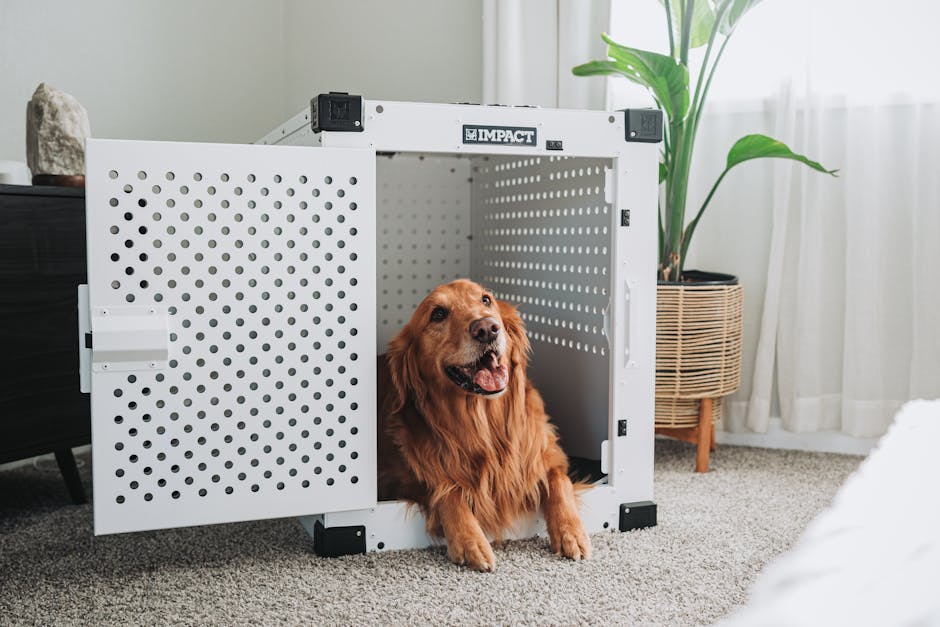
Your puppy should be able to stand up without crouching, turn around fully, and lie on their side with legs extended. If they can’t do all three, the crate is too small. I’ve seen people buy “the right size for their adult dog” and use a divider, but sometimes the divider placement is off by a few inches and the puppy feels cramped.
Get on the floor and actually look at your puppy in the crate. Do they look comfortable? Or are they hunched?
Temperature and Comfort Check
Puppies regulate temperature poorly. If the crate is near a heating vent, in direct sunlight, or in a drafty spot, discomfort can drive the screaming. I keep crates in the bedroom — partly for bonding, partly because that’s where the temperature stays most consistent.
Bedding matters too. Some puppies do better on a flat mat. Others want something they can burrow into. And some anxious puppies will destroy any bedding you put in there, which is itself a sign that simple crate training isn’t going to cut it.
The Slow Desensitization Protocol
Okay. You’ve ruled out physical causes. Your puppy is genuinely struggling with confinement itself. Here’s the method that turned Finn around and that I’ve since recommended to dozens of puppy owners. It’s slower than standard crate training. Plan for two weeks minimum. But it works for the screamers.
The core principle: your puppy should never reach the point of screaming. If they scream, you’ve moved too fast. Back up a step.
Step 1 — Feeding Every Meal in the Crate (Door Open)
For the first 3-5 days, the crate door doesn’t close. Period. Every meal goes in the crate. Scatter kibble toward the back so they have to walk all the way in. If your puppy won’t even approach the crate, put the bowl just inside the opening and move it back an inch each meal.
Don’t make a fuss about it. No coaxing, no cheerful “go to your crate!” voice. Just put the food there and walk away. Let the puppy figure it out.
Between meals, toss high-value treats into the crate randomly. Freeze-dried liver. Small bits of cheese. The crate becomes the place where good things magically appear.
Finn wouldn’t go near his crate the first day. By day three he was napping in it with the door open. That’s what you’re looking for — voluntary entry.
Step 2 — Closing the Door for 5 Seconds
Once your puppy walks into the crate willingly for meals, gently close the door while they’re eating. Count to five. Open it before they finish eating. Do this for every meal for two days.
Five seconds. Not thirty. Not “until they finish eating.” Five.
The goal is for the door closing to be a non-event. They barely notice it happened because food is more interesting. If your puppy freezes, stiffens, or stops eating when the door closes, you moved too fast. Go back to Step 1 for another couple days.
Step 3 — Building Duration in 30-Second Increments
Now you start extending. After closing the door for 5 seconds successfully across multiple meals, go to 10. Then 15. Then 30. Then one minute.
Here’s where people screw up: they jump from 30 seconds to 5 minutes because “it’s going so well!” Don’t do that. The increments should be almost boring.
A sample progression over one week:
- Day 1-2: Door closed for 10-15 seconds during meals
- Day 3: 30 seconds, then 1 minute
- Day 4: 2 minutes with you sitting nearby
- Day 5: 3 minutes with you in the room but not next to the crate
- Day 6: 5 minutes with you moving around the room
- Day 7: 5-8 minutes with brief moments of you stepping out of sight
If at any point your puppy starts showing stress — not just looking at you, but actual stress signals like lip licking, yawning, stiffening — hold at that duration for an extra day or two before advancing.
And always, always end on a win. Open the door while they’re still calm. You want the crate experience to end before they want it to, not after they’ve been pushed past their limit.
Step 4 — Leaving the Room
This is the big leap and where puppy howling in the crate at night usually starts. The key is to make your departures unremarkable.
Stand up. Walk to the doorway. Come back. Treat.
Walk out of sight for 2 seconds. Come back. Treat.
Walk out for 5 seconds. Come back. Treat.
You see the pattern. And yes, it’s tedious. I spent an entire Saturday afternoon doing this with Finn, and I won’t pretend I wasn’t bored out of my mind. But by Sunday evening I could leave the room for 10 minutes without a peep.
Once you can leave the room for 15-20 minutes with a calm puppy, you can start building toward real-world crate time. But don’t rush it. The puppies who scream have already shown you they can’t be rushed.
Crate Alternatives While You’re Training
Here’s something most crate training articles won’t tell you: while you’re working through desensitization, you still need somewhere safe to put the puppy. You can’t just let an 8-week-old puppy roam free while you shower.
Exercise Pens as an Intermediate Step
An exercise pen — or x-pen — is my go-to recommendation for crate screamers. It’s a portable fence that creates a puppy-safe area, usually about 16-24 square feet.
Why it works: many puppies who panic in a crate are fine in an x-pen. The confinement is less intense. They can see out. They can move around. They don’t feel trapped.
Set it up in a puppy-proofed room with a pee pad or newspaper at one end and a bed at the other. It’s not as tidy as crate training, and it does slow down house training slightly. But it keeps your puppy safe without triggering the panic that makes crate training harder in the long run.
I used an x-pen for Finn for three weeks while we worked through the desensitization steps. Once he was comfortable in the crate for 20-minute stretches, we transitioned to crate-only and the x-pen went into the garage.
Tethering Method
Tethering means attaching your puppy’s leash to your belt or a piece of furniture so they can be near you but can’t wander. This works great during the day when you’re home but can’t actively watch the puppy.
It’s not a crate substitute for overnight or when you leave the house. But it reduces the total number of hours your puppy spends in the crate during the training period, which means fewer chances for a screaming meltdown.
I’ll tether a puppy to the couch leg while I’m working. They learn to settle, they’re near me, and the crate pressure is off for a few hours. It’s a pressure valve.
The ‘Two Weeks of Patience’ Mindset
The hardest part of this whole process isn’t the technique. It’s the timeline.
When your puppy screams in its crate, every minute feels like an hour. You’re sleep-deprived. Your partner is frustrated. Your neighbors are giving you looks. And some well-meaning person on a Facebook group has told you their puppy was fine after one night of crying.
Good for them. That’s not your puppy.
Give the desensitization protocol two full weeks before you evaluate whether it’s working. Not two days. Not five. Two weeks of consistent, patient, incremental progress.
Most puppies — even the screamers — will show significant improvement by day 10-14 if you genuinely haven’t pushed too fast. You might not be at “happily sleeps in the crate for 6 hours overnight” yet, but you should be at “can be in the crate for 15-20 minutes without distress.”
If you’re not seeing any progress after two solid weeks of doing this correctly, that’s important information. It might mean you’re dealing with something beyond normal crate training challenges.
When Crate Screaming Indicates Separation Anxiety
I want to be careful here because the internet loves to diagnose every crying puppy with separation anxiety. Most puppies who scream in crates don’t have clinical separation anxiety. They’re just puppies who hate crates.
But some do. And knowing the difference matters because the treatment is different.
Signs That Go Beyond Normal Protest
True separation anxiety in puppies — especially those under 6 months — often has identifiable risk factors:
- Early separation from the litter (before 7 weeks)
- Pet store or puppy mill background where early socialization was poor
- Single-event trauma like being locked in a crate during a thunderstorm or fireworks
- Owner absence pattern changes — puppy was with you 24/7, then suddenly you went back to the office
The behavioral signs that separate anxiety from normal protest:
- Distress happens anytime you leave, not just in the crate
- Destructive behavior when left alone in any confined space
- Refusal to eat in your absence, even after hours
- House soiling that only happens when you’re gone (in a puppy that’s otherwise house trained)
- Following you room to room with visible distress when you go somewhere they can’t follow
If your puppy fits this picture, desensitization alone may not be enough. This is when you talk to your veterinarian — not a trainer, a vet — about whether a short course of anti-anxiety medication might help while you work through the behavioral protocol.
And I know the idea of medicating a puppy feels extreme. It felt extreme to me when our vet suggested it for a friend’s rescue puppy. But Dr. Karen Overall, one of the most respected veterinary behaviorists, has written extensively about how medication combined with behavior modification produces better outcomes than behavior modification alone for true separation anxiety. The medication doesn’t sedate the puppy. It lowers the baseline anxiety enough that they can actually learn.
Options If Your Puppy Truly Can’t Be Crated
Some puppies — a small percentage, but they exist — genuinely cannot tolerate crate confinement. Maybe it’s clinical anxiety. Maybe it’s trauma from a past experience. Maybe it’s a breed thing; some dogs are more claustrophobic than others.
If your puppy truly can’t be crated after working with a veterinary behaviorist, here are your options:
Puppy-proof a room. A bathroom or laundry room with a baby gate works. Remove anything chewable, cover the floors, add a bed and water. It’s not as contained as a crate, but it’s safe.
Use the x-pen long-term. Some dogs never graduate to a crate and that’s okay. An x-pen in your bedroom gives them containment without the claustrophobia trigger.
Daycare or a pet sitter. For the workday hours when you can’t be home, this eliminates the confinement problem entirely. It’s expensive, but if you’re dealing with genuine separation anxiety, it buys you time while the training and medication do their work.
Accept a longer timeline. Some puppies who are crate-nightmares at 10 weeks are perfectly fine at 6 months. Their brains mature, their confidence grows, and suddenly the crate isn’t so scary. Don’t write off the crate forever — revisit it in a couple months.
Finn, my Border Collie screamer? He slept in an x-pen until he was about 4 months old. Then we tried the crate again with the slow protocol, and he took to it within a week. Sometimes puppies just need time to grow up a bit.
Frequently Asked Questions
How long is it normal for a puppy to cry in the crate?
Mild whining for 5-15 minutes is normal and expected, especially during the first few nights. If your puppy settles after that, you’re fine — don’t intervene. But if the crying escalates to screaming, continues past 20-30 minutes, or is getting worse each night rather than better, that’s a sign your approach needs to change.
Should I put the crate in my bedroom?
Yes, especially for puppies who are crate training resistant. Being near you reduces anxiety significantly. You can gradually move the crate to its permanent location once your puppy is sleeping through the night — shift it a few feet each night toward the door. But for the first few weeks, keeping them close makes a real difference.
Will covering the crate help my puppy stop screaming?
Maybe. Some puppies find a covered crate more den-like and calming. Others feel more trapped and it makes things worse. Try it for one session and watch the response. If covering helps, great. If it increases the panic, remove the cover and don’t try it again for at least a week.
My puppy is fine in the crate during the day but screams at night. Why?
Nighttime is different because it combines confinement with darkness, quiet, and your perceived absence (even if you’re in the room). The most common fix is moving the crate right next to your bed so your puppy can see, hear, and smell you. Some owners drape a hand over the side of the crate for the first few nights. It sounds excessive, but it works — and you can withdraw the contact gradually.
At what point should I talk to a vet about my puppy’s crate screaming?
If you’ve done two weeks of proper desensitization, ruled out physical causes, tried alternatives like x-pens, and your puppy is still showing signs of genuine distress — not just annoyance, but panic — it’s time to call your vet. Also contact them immediately if your puppy is injuring itself trying to escape the crate, has stopped eating, or shows anxiety symptoms outside of crate time.
Can certain breeds be harder to crate train?
Absolutely. Breeds with strong attachment tendencies — think Velcro dogs like Cavalier King Charles Spaniels, Vizslas, and German Shepherds — often have a harder time. Working breeds like Border Collies and Australian Shepherds can struggle with the confinement aspect specifically. It doesn’t mean they can’t be crate trained, but you should expect the process to take longer and require more patience than it would with, say, a naturally independent breed.
The fact that you searched for help with crate training that isn’t working tells me something about you — you’re the kind of owner who doesn’t just give up. Your puppy is lucky. This process is going to feel painfully slow some days. But the screamers who get patient, incremental training end up just as crate-comfortable as the puppies who took to it on night one. They just need a different path to get there.
Featured Image Source: Pexels