
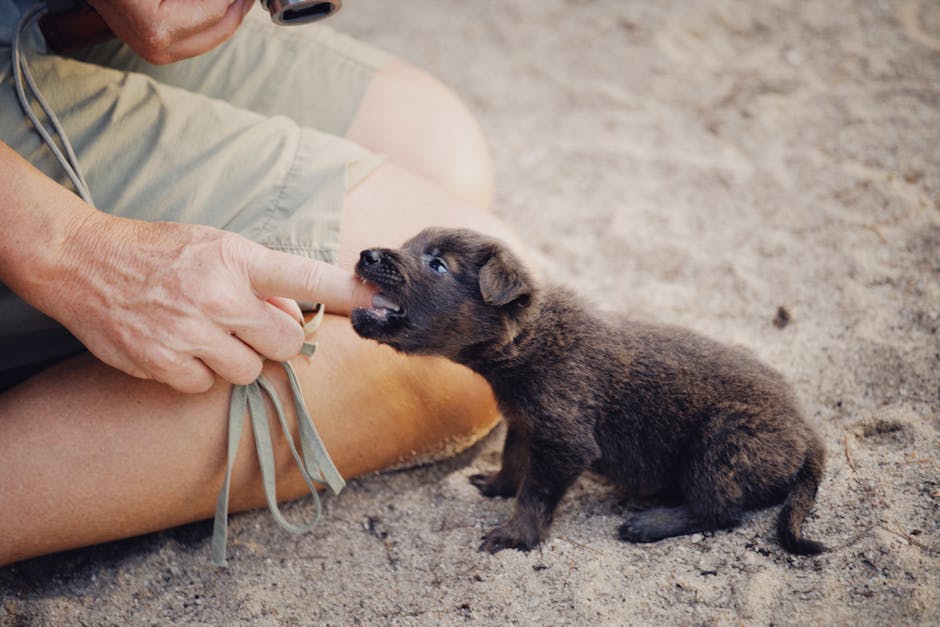

If you’ve got a puppy who’s treating your hands like chew toys, your ankles like prey, and your patience like a renewable resource — I get it. I’ve been there. My Border Collie, Jess, drew blood on me more times in her first four months than I care to admit. And my Golden Retriever puppy? Sweet as pie, but her idea of affection was gnawing on my wrist until I had bruises.
Here’s what nobody tells you: puppy biting won’t stop by age alone. It’s not a switch that flips at some magic month. But it does follow a predictable pattern, and the fixes that work change dramatically depending on how old your puppy is. What works at 8 weeks can actually make things worse at 5 months.
I’ve raised puppies through every phase of this, helped friends with their landshark pups, and spent way too many hours reading Ian Dunbar’s bite inhibition research. So let’s break this down by age — because that’s what actually matters.
Why Puppies Bite (It’s Not Aggression)
First things first. Your puppy isn’t mean. They’re not dominant. They’re not trying to establish pack order. They’re doing exactly what puppies are supposed to do.
Puppies explore the world with their mouths. They don’t have hands, so teeth are how they investigate texture, test boundaries, and figure out social rules. Every single puppy does this. Every breed, every temperament, every litter. It’s as normal as a toddler grabbing everything in sight.
The biting serves real developmental purposes. Through mouthing and play-biting, puppies learn how hard they can bite before it hurts — what researchers call bite inhibition. This is genuinely one of the most important lessons they’ll ever learn. A dog who never learned bite inhibition as a puppy is a dog who could cause real damage as an adult, even accidentally.
So the goal isn’t to stop all mouthing immediately. It’s to shape it. Reduce the pressure first, then reduce the frequency. In that order.
Play Biting vs. Mouthing vs. Warning Signs
Not all biting is the same, and knowing the difference matters more than most people realize.
Play biting looks like this: wiggly body, bouncy movements, biting at hands and clothes during play. The puppy’s body is loose and relaxed. They might growl, but it’s that high-pitched play growl. They come back for more even after you yelp or pull away.
Mouthing is gentler — more like chewing on your hand without much pressure. Some puppies do this when they’re settling down or want affection. It’s the canine equivalent of holding hands, honestly. Annoying, but harmless.
Warning signs are different. Watch for:
– A stiff, rigid body during biting
– Hard eye contact — that fixed, unblinking stare
– Biting that happens over food, toys, or resting spots specifically
– Low-pitched growling that sounds nothing like play
– Snapping without any playful body language before or after
If you’re seeing those warning signs in a puppy under 12 weeks, talk to your vet and a certified behaviorist. That’s not normal puppy stuff. But the vast majority of you reading this? Your puppy is just being a puppy.
8-12 Weeks: The ‘Shark Teeth’ Phase
Those needle teeth are no joke. They’re tiny and ridiculously sharp, and they will puncture skin. I still have a faint scar on my thumb from Jess at 9 weeks old.
But here’s the thing — those sharp teeth are a feature, not a bug. They’re sharp precisely because puppies need to learn that biting hurts before they grow into adult jaws that could do real damage. A sharp tooth that causes a yelp teaches the lesson faster than a blunt one that doesn’t get a reaction.
At this age, your puppy was literally biting their littermates every single day until a couple weeks ago. They’re doing what they know. Your job is to continue the education their siblings started.
Bite Inhibition Training from Littermates
In a litter, here’s what happens roughly a hundred times a day: Puppy A bites Puppy B too hard. Puppy B yelps and stops playing. Puppy A learns “oh, that was too much.” Game resumes. Repeat.
This is Ian Dunbar’s core insight — puppies need to learn pressure control before they learn to stop biting entirely. If you skip straight to “no biting ever,” you end up with a dog who rarely mouths but has never learned how hard is too hard. And if that dog ever does bite — out of fear, pain, or surprise — they have no graduated response. It’s zero or full force.
Puppies who were separated from their litter before 7-8 weeks often have worse bite inhibition. They missed those critical weeks of feedback from siblings. If that’s your puppy, you’ll need to be more patient and more deliberate about this training.
The Yelp-and-Redirect Method
This is the standard advice, and it works — for some puppies. Here’s how to do it properly:
- When your puppy bites too hard, make a sharp, high-pitched “OW!”
- Immediately go still. Hands go limp, eye contact breaks
- Wait 3-5 seconds
- Resume play calmly
- If they bite hard again, repeat — but this time, stand up and turn away for 15-20 seconds
The key word there is “too hard.” At 8-10 weeks, you’re only reacting to the hardest bites. Gentle mouthing gets no reaction. You’re shaping the pressure down gradually, not trying to eliminate all mouth contact at once.
But here’s what nobody warns you about: the yelp method backfires with some puppies. Herding breeds — Border Collies, Australian Shepherds, Shelties — often get more excited by high-pitched sounds. The yelp becomes a game. If your puppy gets more wound up when you yelp, drop that method immediately and go straight to the “be boring” approach: silently stand up, turn your back, leave the room if needed. No drama, no sound effects. Just an immediate end to the fun.
3-4 Months: Teething Intensifies Biting
Right when you think you’re making progress, teething hits. And everything gets worse.
Between 12-16 weeks, your puppy’s adult teeth start pushing through. Their gums hurt, their mouth is uncomfortable, and biting on things provides relief. It’s not a behavior problem — it’s a pain management strategy. Understanding that distinction makes a huge difference in how you respond.
You might notice your puppy chewing on furniture, baseboards, shoes — things they weren’t interested in before. They might bite harder during play. They might seek out cold or firm textures. All normal.
Redirecting to Appropriate Chew Targets
This is where having the right chew toys becomes non-negotiable. Not all chew toys are equal for a teething puppy.
| Chew Type | Best For | Avoid If |
|---|---|---|
| Frozen washcloths | Sore gums, 3-4 months | Puppy swallows fabric |
| Rubber Kongs (frozen) | Extended chewing, any age | — |
| Bully sticks | Serious chewers, 4+ months | Puppy tries to swallow large chunks |
| Nylabones | Moderate chewers | Puppy breaks off pieces |
| Ice cubes | Quick gum relief | Puppy ignores them (some do) |
When your puppy bites your hand, immediately — and I mean within one second — swap your hand for an appropriate chew toy. Don’t pull your hand away and then fumble for a toy. Have them stashed everywhere. I kept frozen Kongs in every room of the house during Jess’s teething phase. Overkill? Maybe. But it worked.
The swap needs to be instant and boring. No big reaction to the bite, no excitement about the toy. Just a calm swap. You’re teaching them that hands end fun but toys continue it.
Why Hands Are Not Toys (And How to Undo It)
If someone in your household has been wrestling with the puppy using their hands — and there’s always someone — you need to stop that today. Not tomorrow. Today.
I know rough play is fun. Puppies love it. But every time someone lets a puppy gnaw on their hands during play, they’re teaching that puppy that human skin is an appropriate play target. And then the puppy doesn’t understand why it’s okay with Dad but not with the toddler.
To undo hand-play habits:
- Everyone in the house has to be consistent. One person playing rough undoes everyone else’s training
- Always have a tug toy for interactive play instead. Tug is great — hands are not
- If the puppy goes for hands during tug, the game ends immediately. Drop the toy, stand up, wait
- Redirect every single time. It takes 2-3 weeks of consistency to break the habit
5-6 Months: When Biting Should Be Declining
By 5 months, your puppy’s adult teeth are mostly in. The teething pain is subsiding. And if you’ve been consistent with training, you should see a real decrease in biting frequency and intensity.
But what if you’re not? What if your puppy is biting harder at 5 months than they were at 3 months? That’s when people start to panic — and honestly, it’s worth paying attention to.
What It Means If It’s Getting Worse
A mouthy puppy at 5-6 months doesn’t automatically mean something is wrong. Some breeds are just mouthier than others — Retrievers, Spaniels, and any breed developed to carry things in their mouths tend to take longer. Herding breeds bite at moving targets (your ankles, your kids) because that’s literally what they were bred to do.
But if the biting is escalating — getting harder, more frequent, or happening outside of play — consider these possibilities:
Not enough exercise or mental stimulation. A bored, under-exercised 5-month-old puppy will find outlets. Biting you is exciting. It gets a reaction. It’s better than staring at the wall. Before assuming it’s a behavior problem, honestly assess whether your puppy is getting enough physical activity and brain work.
Overtiredness. This one surprises people. Puppies who are overstimulated or overtired get bitey, just like exhausted toddlers get cranky. If the biting happens after long play sessions or busy days, your puppy might need more enforced nap time. At 5 months, they still need 16-18 hours of sleep per day.
Inconsistent training. If different family members respond differently to biting — one person yelps, another pushes the puppy away (which feels like play), another laughs it off — the puppy has no clear picture of the rules.
Adolescent Resource Guarding vs. Puppy Biting
Here’s where it gets important to distinguish between a mouthy puppy vs. aggressive puppy behavior. Around 5-6 months, some puppies start showing early resource guarding — growling, snapping, or biting when you approach their food bowl, take away a stolen sock, or try to move them off the couch.
This is different from play biting. The body language is different. The context is different. And the fix is completely different.
Resource guarding in a young dog is very fixable, but don’t try to “show them who’s boss” by taking things away forcefully. That makes guarding worse. Instead:
- Practice trading: approach with something better, trade for what they have
- Hand-feed meals for a few weeks to build positive food associations
- Work with a certified trainer (CPDT-KA or similar credential) if the guarding involves actual snapping
Play biting should be managed with the redirection strategies above. Resource guarding needs a specific desensitization protocol. Mixing them up leads to the wrong approach for both problems.
Methods That Backfire
The internet is full of puppy biting advice. Some of it is great. Some of it will make your problem worse and damage your relationship with your dog. Let me save you some grief.
Why Holding the Mouth Shut Doesn’t Work
I see this recommended constantly and it drives me nuts. The idea is that you hold the puppy’s muzzle closed when they bite to teach them “no.” What it actually teaches them is that your hands near their face mean something unpleasant is about to happen.
The results? A puppy who:
– Becomes hand-shy (flinches or snaps when hands approach their face)
– Is harder to handle at the vet
– Resists having teeth brushed or muzzle examined
– May actually bite harder out of frustration or fear
Your puppy doesn’t understand that the muzzle hold is a consequence for biting. They just know that sometimes you grab their face and it’s uncomfortable. The association you’re building isn’t “I shouldn’t bite” — it’s “hands near my face are bad.” Completely different lesson.
Alpha Rolls and Dominance Myths
And then there’s the alpha roll — flipping your puppy onto their back and holding them down. Let me be blunt: don’t do this. Ever.
The “dominance theory” this is based on has been debunked by the very researcher (David Mech) whose 1970s wolf study it was built on. He’s spent decades trying to correct the record. Wolves don’t actually work this way, and dogs definitely don’t.
What an alpha roll actually does:
– Frightens your puppy
– Damages trust
– Can trigger a genuine fear-based bite (which you then punish, creating a terrible cycle)
– Teaches your puppy that physical intimidation is how conflicts get resolved
The puppies who “submit” to alpha rolls aren’t learning — they’re shutting down. That’s not respect. It’s learned helplessness. And the puppies who fight back? Those are the ones who end up labeled “aggressive” when they were just scared.
Positive reinforcement isn’t permissive. It’s not letting your puppy do whatever they want. It’s teaching them what to do instead of what not to do, and making the right choice rewarding. It works faster, lasts longer, and doesn’t risk your relationship.
When Puppy Biting Is Actually a Red Flag
I’ve spent this whole article telling you that puppy biting is normal. And it is — usually. But there are situations where biting indicates something more serious, and it’s important to recognize them early.
Stiff Body Language During Biting
The single biggest indicator that biting has crossed from play into a problem is body language. Normal play biting comes with a loose, wiggly body. Concerning biting comes with tension.
Watch for these specific signals happening during the bite:
– Whale eye — you can see the whites of their eyes because they’re looking sideways while holding their head still
– Stiff tail — not wagging, or wagging stiffly at the tip only (a stiff wag is not a happy wag)
– Forward weight — the puppy is leaning into you rather than bouncing back
– Closed mouth between bites — play-biting puppies have loose, open mouths; tense puppies clamp down
– No play signals — no play bows, no bouncing, no wiggly body before the bite
One of these in isolation might mean nothing. Several together, happening repeatedly? That’s a puppy who needs professional evaluation. Not in three months. Now.
Breed-Specific Bite Considerations
Some breeds are mouthier than others, and that’s just genetics. Knowing what’s normal for your breed helps you calibrate your expectations.
Naturally mouthy breeds (expect more biting, longer duration):
– Golden Retrievers and Labrador Retrievers — bred to carry things, mouth-oriented
– Spaniels — same reason
– German Shepherds — mouthy plus nippy
– Pit Bull types — strong jaws, love tug, tend to mouth during excitement
Breeds that nip at heels and ankles:
– Border Collies, Australian Shepherds, Corgis, Shelties — herding instinct
– This isn’t aggression. It’s their job. Redirect to appropriate herding games
Breeds where early biting needs closer monitoring:
– Guardian breeds (Akitas, Cane Corsos, Anatolian Shepherds) — naturally protective, lower bite inhibition tolerance
– If these breeds show stiff-bodied biting at any age, get professional help immediately
The fact that your Lab puppy is still mouthing at 6 months isn’t the same concern as a guardian breed puppy doing the same thing. Context matters.
Frequently Asked Questions
When do puppies stop biting?
Most puppies significantly reduce biting between 6-8 months, once adult teeth are fully in and bite inhibition training has had time to work. But “stop” is gradual, not sudden. You’ll notice the bites getting softer first, then less frequent. Some mouthy breeds — Retrievers especially — may continue gentle mouthing into adulthood as an affection behavior. That’s different from the painful puppy biting and usually isn’t a problem.
My puppy only bites me and not my partner. Why?
This is incredibly common and usually means one of two things: either your puppy is more excited around you (you’re more fun, you play more actively), or your partner is more consistent with the redirection training. It could also be a movement thing — if you’re the one who moves faster, waves hands more, or gets more animated, you’re a more exciting target. Try being deliberately boring when the biting starts.
Is it normal for a puppy to growl while biting during play?
Yes, play growling is completely normal. The play growl is usually higher-pitched, comes with a wiggly body, and happens in bursts. It sounds different from a serious growl, which tends to be lower, longer, and comes from a stiff dog. If you’re not sure which you’re hearing, video it and show a trainer. But most play growling is exactly that — play.
Should I use a spray bottle to stop puppy biting?
No. Spray bottles might stop the behavior in the moment, but they don’t teach your puppy what to do instead. They also create negative associations with your hands (since you’re holding the bottle) and can make some puppies hand-shy or fearful. Redirection and removal of attention are more effective and don’t risk side effects.
My 5-month-old puppy’s biting is getting worse, not better. Is this normal?
It can be, especially if your puppy is still finishing teething or going through an adolescent energy spike. But puppy biting harder at 5 months deserves attention. Make sure your puppy is getting enough exercise, sleep, and mental enrichment. Check that everyone in the household is using the same approach. If you’re doing everything right and the biting is still escalating — especially if it’s accompanied by stiff body language — book a session with a certified trainer. Better to get professional eyes on it now than wait.
Look, puppy biting is exhausting. There were moments with Jess where I genuinely questioned whether I’d made a terrible decision getting a Border Collie puppy. My hands looked like I’d lost a fight with a rosebush. But she grew out of it — because we were consistent, because we understood what was normal for her age, and because we didn’t resort to methods that would’ve damaged her trust.
Your puppy will get through this too. Match your approach to their age, be patient with the process, and remember that this annoying, painful phase is actually teaching them one of the most important skills they’ll ever have. A dog with good bite inhibition is a safer dog for life.
Featured Image Source: Pexels