

I watched my neighbor’s Golden Retriever choke on a tennis ball chunk two summers ago. The whole thing lasted maybe ninety seconds, but it felt like an hour. His owner, Mark, just stood there frozen — phone in one hand, the other hand shaking. I’d taken a pet first aid course the year before on a whim, mostly because my vet suggested it after my Labrador Beau had a seizure episode. That course is the only reason I knew what to do.
The dog was fine. But Mark wasn’t, not for weeks. He kept saying, “What if you hadn’t been there?” And honestly? That question haunts me too. Because most dog owners — good, loving, devoted dog owners — have absolutely no idea how to perform CPR on their pet. They’d call the vet, sure. But what do you do in those three to fifteen minutes before help arrives?
That’s what this guide is for. Not to replace veterinary care, not to make you a canine paramedic. But to give you something real to do when the worst moment of your dog-owning life is happening right in front of you.
When Does a Dog Actually Need CPR?
Let’s get one thing straight: dog CPR isn’t something you should be doing casually. This is a last-resort intervention for when your dog has stopped breathing, has no heartbeat, or both. We’re talking about genuine cardiac or respiratory arrest.
Here are the situations where you might need it:
- Drowning — and it happens more than you’d think, especially with brachycephalic breeds like Bulldogs and Pugs who are terrible swimmers
- Choking on food, toys, bones, or sticks
- Electrocution from chewing cords (puppies are notorious for this)
- Severe allergic reactions causing airway swelling
- Trauma — being hit by a car, falling from height
- Smoke inhalation during a house fire
- Heatstroke that’s progressed to organ failure
- Poisoning from toxins like xylitol, chocolate, or antifreeze
The key phrase here is unresponsive and not breathing. If your dog is conscious and breathing, even if they’re struggling, CPR isn’t the move. Focus on getting to an emergency vet. CPR is for when that isn’t an option yet.
How to Check If Your Dog Needs CPR
Before you start chest compressions, you need to confirm your dog actually needs them. Performing CPR on a dog that’s breathing can cause serious harm — broken ribs, punctured lungs, cardiac arrhythmia.
The ABC Check
Think A-B-C: Airway, Breathing, Circulation.
Airway: Gently open your dog’s mouth and look inside. Is there an obstruction? A piece of toy, food, vomit? If you can see it and reach it safely, sweep it out with your finger. Don’t go blindly fishing around — you could push something deeper.
Breathing: Hold the back of your hand near your dog’s nostrils and mouth. Can you feel air? Watch their chest — is it rising and falling? Even slight movement counts. No movement for 10 seconds means they’re not breathing.
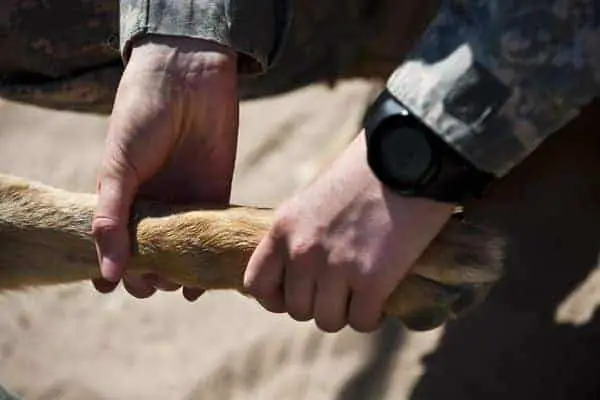
Circulation: Check for a pulse. The easiest spot is the femoral artery on the inner thigh, right where the back leg meets the body. Press gently with two fingers. On larger dogs, you can also try placing your hand directly on the left side of the chest, just behind the elbow.
No breathing and no pulse? That’s when you start CPR.
And look — finding a pulse on a dog is hard even when you’re calm. I’ve practiced on Beau at home, and even knowing exactly where to press, it took me a good fifteen seconds. In a panic, with adrenaline flooding your system? Much harder. If you can’t find a pulse and they’re not breathing, err on the side of starting CPR. Time matters more than certainty.
How to Perform Dog CPR: Step by Step
The technique varies based on your dog’s size, which trips people up. A Chihuahua and a Great Dane need very different approaches.
Step 1: Position Your Dog
Lay them on their right side on a firm, flat surface. Straighten the neck to open the airway — don’t hyperextend it, just get it in a natural, slightly stretched line. Pull the tongue forward and to the side so it doesn’t block the throat.
Step 2: Chest Compressions
This is where size matters.
| Dog Size | Technique | Hand Position | Compression Depth |
|---|---|---|---|
| Small (under 10 lbs) | One-hand wrap around chest | Directly over the heart | 1/4 to 1/3 of chest width |
| Medium (10-40 lbs) | One hand, heel on ribs | Widest part of the chest | 1/3 to 1/2 of chest width |
| Large (over 40 lbs) | Two hands stacked | Widest part of the chest | 1/3 to 1/2 of chest width |
| Barrel-chested (Bulldogs, Pugs) | Dog on their BACK | Directly over the breastbone | 1/3 to 1/2 of chest width |
Rate: 100 to 120 compressions per minute. That’s fast — about two per second. The old trick of compressing to the beat of “Stayin’ Alive” by the Bee Gees works just as well for dogs as it does for people. Seriously.
For small dogs and puppies, I want to stress this: you can wrap one hand around the chest with your thumb on one side and fingers on the other, then squeeze. It feels weird, almost like you’re going to hurt them. But you need to compress firmly. Gentle doesn’t save lives here.
Let the chest fully recoil between compressions. Don’t keep pressure on. That recoil is what lets the heart refill with blood.
Step 3: Rescue Breaths
After every 30 compressions, give 2 rescue breaths.
Here’s how: Close your dog’s mouth with your hand, sealing the lips. Place your mouth over their nostrils — yes, their nose — and blow gently until you see the chest rise. For small dogs, cover both the nose and mouth with your mouth.
Don’t blow hard. You’re not inflating a balloon. A gentle, steady breath that makes the chest visibly rise is what you’re after. If the chest doesn’t rise, recheck the airway for obstructions and reposition the head.
Step 4: The Cycle
30 compressions. 2 breaths. Repeat.
Check for breathing and a pulse every 2 minutes. If someone else is with you, switch who does compressions every 2 minutes — this is exhausting work, and your compressions get weaker when you’re tired, even if you don’t realize it.
How Long Should You Keep Going?
This is the question nobody wants to answer, and I’ll be honest with you — there’s no clean answer.
Continue CPR until your dog starts breathing on their own, you arrive at a vet clinic and they take over, or you’ve been going for 20 minutes with no response.
That 20-minute mark is the general guidance from veterinary emergency specialists. After 20 minutes of properly performed CPR with no return of spontaneous circulation, survival is extremely unlikely. I know that’s brutal to read. But it’s better to know this ahead of time than to face that decision in the moment with zero framework.
Here’s what I’ll also say: CPR success rates in dogs are low. Studies put it somewhere between 4% and 6% for out-of-hospital cardiac arrest. That’s not meant to discourage you — those are lives saved that would’ve been lost. But I want you going in with realistic expectations. The goal of CPR is often to buy time until professional veterinary intervention is possible, not to be the complete solution.
Common Mistakes That Can Make Things Worse
I’ve talked to two emergency vets about this, and they both mentioned the same handful of errors they see.
Compressing too gently. This is the biggest one. People are terrified of hurting their dog, which is understandable. But ineffective compressions do nothing. You need to compress a third to half the width of the chest. Yes, you might crack a rib. That’s better than the alternative.
Forgetting to check the airway first. If there’s an obstruction and you’re just doing compressions, you’re pumping blood that has no oxygen. Check the mouth. Clear the airway.
Blowing too hard during rescue breaths. This can send air into the stomach instead of the lungs, causing distension and vomiting — which then becomes a choking hazard.
Not letting the chest recoil. Leaning on the chest between compressions prevents the heart from refilling. Compress, release completely, compress again.
Performing CPR on a dog that doesn’t need it. Panicked owners sometimes start compressions on a dog that’s unconscious but still breathing. This can cause cardiac arrhythmia in a beating heart. Always do the ABC check first.
Choking: The Emergency That Comes Before CPR
A lot of dog CPR situations start with choking. If your dog is pawing at their mouth, gagging, making high-pitched wheezing sounds, or turning blue around the gums, they’re probably choking.
For conscious choking dogs:
Open the mouth and look. If you can see the object, try to grab it with your fingers or pliers. Be careful — a panicked dog may bite, even a dog who’s never bitten anyone.
If you can’t dislodge it manually, try a modified Heimlich maneuver:
- Small dogs: Hold them with their spine against your chest, head up. Place a fist just below the ribcage and give 5 firm upward thrusts.
- Large dogs: Stand behind them (if they’re standing) or kneel behind them. Place your fist just behind the last rib and thrust firmly upward and forward 5 times.
After each set of thrusts, check the mouth again. Repeat up to 3 times.
If the object comes loose but your dog isn’t breathing afterward — that’s when you start CPR.
My friend’s Beagle, Cooper, choked on a rawhide piece last year. She did the Heimlich, got it out in two thrusts, and Cooper was running around the backyard ten minutes later. But she told me later her hands didn’t stop shaking for hours. That’s normal. That’s adrenaline. You don’t have to be calm to save your dog — you just have to act.
Preparing Before the Emergency Happens
Here’s the thing I really want you to hear: reading this article is step one, not the finish line.
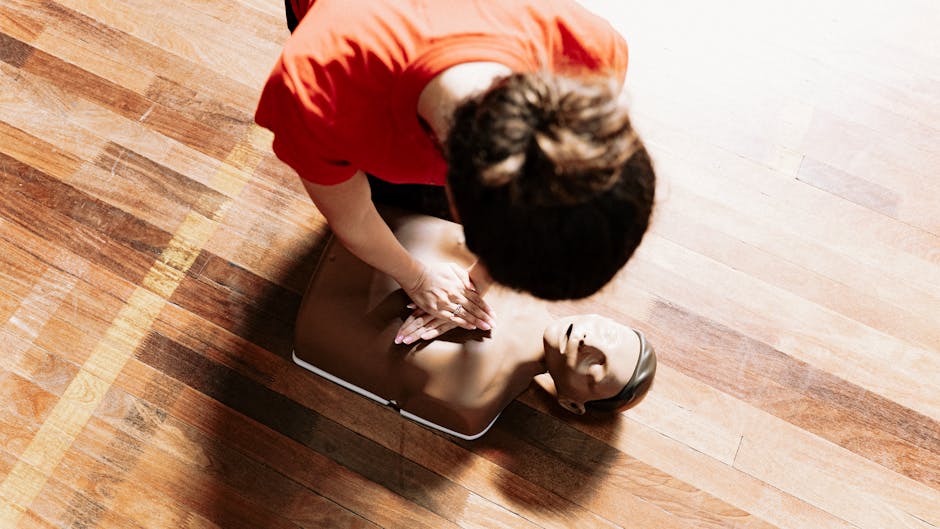
Take a pet first aid course. The Red Cross offers one. Several organizations do online versions too. Practicing on a stuffed animal or mannequin makes an enormous difference compared to just reading instructions. I took mine through the Red Cross pet first aid program and it was about 4 hours.
Know your nearest 24-hour emergency vet. Program the address and phone number into your phone right now. Not next week. Now. When you’re panicking, you don’t want to be Googling.
Keep a pet first aid kit. Nothing elaborate — gauze, medical tape, hydrogen peroxide (for induced vomiting only under vet direction), a digital thermometer, a muzzle (injured dogs bite), and a card with your vet’s number and the ASPCA Poison Control number (888-426-4435).
Practice finding your dog’s pulse. Seriously, do it tonight while you’re watching TV. Get comfortable locating that femoral artery on the inner thigh. It’s way easier to learn when nobody’s dying.
Post instructions somewhere visible. I’ve got a laminated card on my fridge with the basic CPR steps and emergency numbers. Sounds paranoid. Don’t care.
Frequently Asked Questions
Can I break my dog’s ribs doing CPR?
Yes, and it’s more common than you’d think — especially with smaller dogs or older dogs with brittle bones. But here’s the reality: a dog in cardiac arrest is going to die without intervention. Broken ribs heal. Death doesn’t. Compress firmly and don’t hold back out of fear.
Should I perform CPR if my dog is choking but still conscious?
No. If your dog is conscious and trying to cough or gag, their body is doing its job trying to clear the obstruction. Focus on the Heimlich maneuver technique described above. CPR is only for dogs that are unconscious and not breathing. If they lose consciousness and stop breathing during a choking episode, then you switch to CPR.
Is mouth-to-snout breathing safe for humans?
Generally yes. You’re breathing into their nose, not their mouth. The main risk is if your dog has been exposed to a toxin and has residue around the muzzle — in that case, wipe the area first. The risk to you is minimal compared to the risk to your dog from not breathing.
How is dog CPR different from human CPR?
The biggest differences: dogs are positioned on their side (not their back, except barrel-chested breeds), you breathe into their nose rather than their mouth, and the hand positioning varies significantly based on the dog’s size and chest shape. The compression-to-breath ratio is the same — 30:2 — and the compression rate is the same at 100-120 per minute.
At what age should I learn pet CPR?
Any age you’re responsible for a dog. I’d argue anyone over 12 or 13 who’s regularly home alone with the family dog should know the basics. Pet first aid courses are straightforward and don’t require any medical background.
One Last Thing
Nobody wants to think about their dog dying. I get it — I’ve had three dogs in my life, and the thought of losing any of them makes my stomach drop. But this isn’t morbid preparation. It’s love in its most practical form.
The odds that you’ll ever need to perform CPR on your dog are low. But if that moment comes, you’ll either know what to do or you won’t. And the difference between those two things is just a bit of preparation.
Go find your dog’s pulse tonight. Bookmark this page. Look up your nearest emergency vet. Do the small things now so that if the big thing ever happens, you’re not standing there like Mark — frozen, terrified, and helpless.
Featured Image Source: Pexels