
The Reality Behind Police Dog Training
I’ve been around dogs my whole life — trained them, fostered them, watched them do things that genuinely blew my mind. But nothing quite prepared me for the first time I watched a police K-9 demonstration at our county fair. A Belgian Malinois hit a bite sleeve at full speed, and the sound alone made half the crowd flinch. That dog went from relaxed to full intensity in maybe two seconds flat.
What struck me most wasn’t the aggression, though. It was the control. One word from the handler and that dog released, sat, and looked up like nothing happened. That level of training doesn’t happen by accident. It’s the result of months — sometimes over a year — of incredibly specific, disciplined work that most pet owners can barely imagine.
Police dog training is one of those things people think they understand from watching TV. They don’t. The real process is far more interesting, far more demanding, and honestly? It gives you a whole new respect for what dogs are capable of when they’re matched with the right handler and the right program.
Where It All Starts: Selecting the Right Dog
Not every dog gets to be a K-9 officer. Not even close.
Most departments in the US source their dogs from specialized breeders in Europe — Germany, the Netherlands, Czech Republic. Belgian Malinois dominate modern K-9 units, and it’s not hard to see why. They’re lighter, faster, and more agile than German Shepherds, with an almost obsessive work drive. German Shepherds still make up a solid chunk of working dogs, but Malinois have been taking over for the last 15 years or so.
Some departments also use Dutch Shepherds, and you’ll occasionally see Labrador Retrievers or Springer Spaniels in detection-only roles. But for dual-purpose patrol dogs — the ones doing both apprehension and detection — it’s Malinois all day.
The selection process starts when dogs are 12–18 months old. Evaluators are looking for very specific traits:
- High prey drive — the dog needs to be absolutely obsessed with chasing and catching things
- Confidence — no fear of loud noises, strange surfaces, crowds, or unfamiliar environments
- Resilience — the dog has to bounce back quickly from stress or confusion
- Toy/reward motivation — this is actually what makes the whole training system work
Here’s something that surprises people: aggression isn’t on that list. Departments don’t want aggressive dogs. They want dogs with controllable intensity. There’s a massive difference. An aggressive dog is a liability. A driven dog with an off switch? That’s a K-9.
Most candidates wash out. Some estimates put the selection rate at around 40–50% — and these are dogs that were specifically bred for this type of work. The bar is that high.
The Handler Bond: More Than Just a Partnership
Before a single command gets trained, the dog and handler need to build a relationship. This is the part that doesn’t make it into the TV shows.
New K-9 handlers typically spend the first couple weeks just living with the dog. Feeding, walking, playing — building trust. The dog needs to see this person as the center of their universe. Not out of fear, but because the handler becomes the source of everything good. Food, toys, play, praise. Everything.
I’ve talked to a couple of K-9 officers over the years, and they all say the same thing: the bond is the foundation. If the dog doesn’t trust the handler completely, nothing else works. The dog won’t perform under stress, won’t recall reliably, won’t make good decisions in chaotic situations.
Most handlers keep their dogs at home — not in a kennel at the station. These dogs ride in the patrol car every shift, sleep in the handler’s house, play with the handler’s family. They’re working partners 24/7. It’s a relationship unlike anything else in law enforcement.
Basic Obedience: The Non-Negotiable Foundation
You might think police dog training jumps straight to the exciting stuff — biting, searching, tracking. Nope. It starts exactly where your puppy class started. Sit. Down. Stay. Heel. Come.
The difference? The standard is absurdly high.
A pet dog that sits 80% of the time is considered pretty well trained. A police K-9 needs to respond correctly every single time, in any environment, under any level of distraction. Gunshots going off? Sit means sit. Other dogs barking? Down means down. A suspect running? If the handler says stay, that dog doesn’t move.
This phase typically takes 2–4 weeks of intensive daily work and relies heavily on positive reinforcement — specifically marker training (similar to clicker training). The dog performs correctly, hears the marker, gets the reward. Over and over, hundreds of times a day.
| Command | Pet Dog Standard | K-9 Standard |
|---|---|---|
| Recall | Comes most of the time | Instant recall under extreme distraction |
| Stay | Holds for a minute or two | Holds indefinitely until released |
| Heel | Walks without pulling | Precise positioning regardless of environment |
| Out/Release | Eventually lets go | Immediate release on first command |
That “Out” command — the instant release — is arguably the most important thing a police dog ever learns. It’s what makes the difference between a controlled apprehension and a lawsuit.
Patrol Training: Apprehension and Suspect Search
This is the part people think of when they hear “police dog.” And yeah, it’s intense.
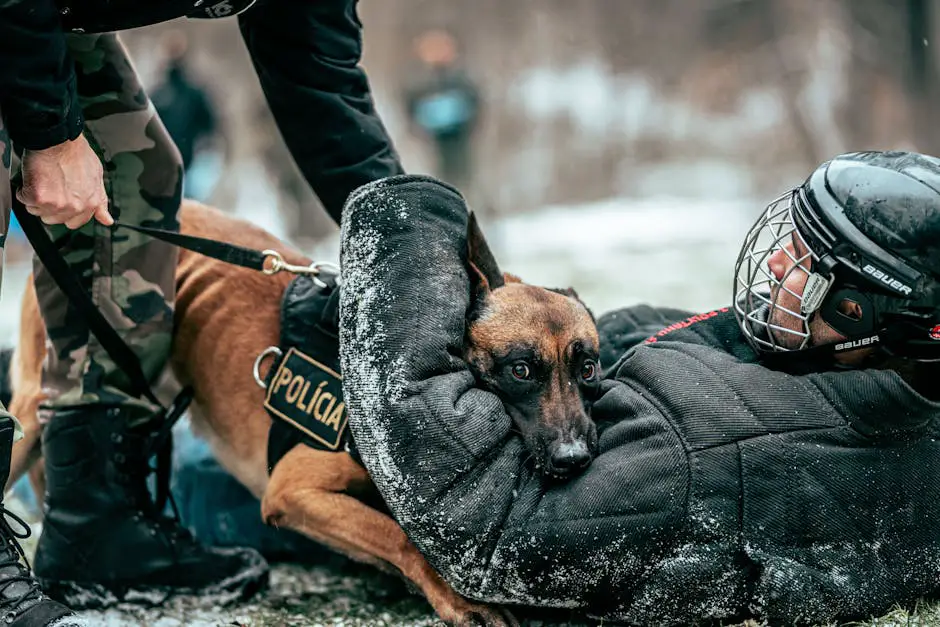
Bite work starts with basic prey drive exercises. The dog chases a tug toy, then a sleeve, then a full bite suit. The progression is gradual and careful. At no point is the dog being taught to be aggressive — it’s being taught that biting the equipment is the best game in the world, and the handler controls when the game starts and stops.
Over weeks, the scenarios get more complex. The decoy (the person in the bite suit) starts hiding. Then running. Then fighting back. Then yelling. The dog learns to engage a suspect who’s resisting, hold the bite, and release instantly on command.
Building searches are another major component. The dog learns to systematically clear rooms, indicate where a hidden person is, and either bark to alert or hold the suspect until the handler arrives. The dog needs to work independently here — the handler might be 50 feet away around a corner.
What amazed me watching this stuff in person was the dog’s ability to switch modes. Playing fetch in the yard one minute, full-intensity apprehension the next, then back to calm and relaxed. That emotional regulation isn’t natural — it’s trained.
And here’s the thing nobody talks about: the dog thinks it’s all a game. Seriously. That Malinois hitting the bite sleeve at 30 mph? In its mind, it’s playing the most fun game ever invented. The reward at the end is usually a ball or tug toy. That’s the secret behind police dog training — the dog isn’t working out of duty or obligation. It’s working because it’s been conditioned to find this stuff incredibly rewarding.
Detection Training: Nose Work That Saves Lives
Detection is where dogs truly outshine any technology we’ve built. A trained detection dog can identify scents at concentrations as low as one part per trillion. That’s like finding one drop of liquid in 20 Olympic swimming pools.
Detection dogs are trained using a method called odor imprinting. The target scent — drugs, explosives, firearms, whatever the specialty — gets paired with the dog’s favorite reward. The dog smells the target odor, indicates (usually by sitting or scratching at the source), and gets their toy.
The training starts dead simple. Open containers, obvious placement, easy finds. Then it gets progressively harder:
- Scent hidden in sealed containers
- Multiple distracting odors present
- Scent residue only (the item was there but was removed)
- Moving vehicles
- Large open areas like warehouses or schools
Dual-purpose dogs learn both patrol work and detection, which is why their training takes longer — usually 12–16 weeks of initial academy work. Single-purpose detection dogs can be trained in 8–10 weeks, though they continue training throughout their career.
One thing I find fascinating: dogs can be trained to detect specific substances without ever being exposed to the actual drug or explosive. Trainers use synthetic training aids that mimic the chemical signature. So no, the police dog hasn’t actually been around cocaine — it’s been trained on a pseudo-scent that triggers the same olfactory response.
Ongoing Training and Certification
Here’s what separates police K-9 training from regular dog training: it never stops.
Most departments require K-9 teams to train a minimum of 16 hours per month after their initial certification. Many do more. The training covers every discipline — obedience refreshers, new bite scenarios, detection problems in novel environments, tracking exercises.
K-9 teams also have to recertify regularly, usually annually. Certification standards vary by state and organization, but most follow guidelines from groups like the National Police Canine Association (NPCA) or United States Police Canine Association (USPCA). Fail your certification and your dog gets pulled from active duty until you pass.
The handler is learning constantly too. Reading the dog’s body language, recognizing stress signals, adjusting technique. A good handler knows when their dog is tired, frustrated, confused, or over-threshold. Bad handling can undo months of training in a single session.
Most police dogs serve 6–9 years before retirement. After that, they typically stay with their handler as a pet. After everything they’ve been through together, you’d have a hard time separating them anyway.
The Cost and Commitment Behind K-9 Units
Running a K-9 unit isn’t cheap. A single trained police dog costs $12,000–$25,000 to purchase. Then add the handler’s specialized training (another $10,000–$15,000), veterinary care, equipment, food, and the patrol vehicle modifications needed to transport a dog safely.
All told, a department might spend $50,000–$75,000 in the first year of a K-9 team, with $15,000–$25,000 annually after that. Smaller departments often rely on donations, fundraisers, and grants to fund their K-9 programs.
But the investment pays off. A single K-9 team can search a building in minutes that would take a dozen officers an hour. Detection dogs find things human officers simply can’t. And the deterrent effect is real — I’ve heard multiple officers say suspects give up immediately once they hear the dog.
Frequently Asked Questions
What age do police dogs start training?
Most police dogs begin their formal K-9 academy training between 12 and 24 months old, though many come from breeding programs where basic drive-building exercises start much earlier. The sweet spot seems to be around 14–18 months — old enough to handle the physical demands but young enough to be shaped effectively.
Can any breed become a police dog?
Technically, any breed with sufficient drive could learn detection work. But for dual-purpose patrol roles, it’s almost exclusively Belgian Malinois, German Shepherds, and Dutch Shepherds. These breeds combine the physical ability, drive, and temperament needed for apprehension work. Labs and Spaniels are popular for detection-only roles because of their incredible noses and non-threatening appearance.
Do police dogs live with their handlers?
Yes, almost always. The dog lives at the handler’s home, rides in the patrol car during shifts, and is essentially a member of the family. This 24/7 bond is a critical part of what makes K-9 teams effective — the handler learns to read the dog’s subtle signals, and the dog trusts the handler completely.
How long does it take to train a police dog?
Initial academy training typically runs 12–16 weeks for dual-purpose dogs and 8–10 weeks for detection-only dogs. But that’s just the beginning. K-9 teams train continuously throughout the dog’s career — a minimum of 16 hours per month for most departments, with annual recertification requirements.
What happens to police dogs when they retire?
Most retired K-9s stay with their handler as a family pet. Some states have actually passed laws ensuring handlers get first right of adoption. After spending 6–9 years working together daily, the bond between handler and dog is incredibly strong. These dogs usually transition to retirement life pretty well — turns out chasing a ball in the backyard isn’t that different from their favorite reward during training.
Final Thoughts
The more you learn about police dog training, the more you realize it’s really just exceptional dog training taken to its logical extreme. The same principles that teach your Golden Retriever to shake — motivation, timing, consistency, relationship — are what produce a K-9 that can track a suspect through a city or find a hidden stash in a warehouse full of distractions.
What makes it special isn’t some secret military technique. It’s the commitment. Hours every single day, for the entire working life of the dog, with a handler who treats that animal as a true partner. That’s what makes a police dog. And honestly, it’s made me a better dog owner just understanding how it works.
Featured Image Source: Pexels