

The first time I watched my Golden Retriever puppy, Rosie, lose a baby tooth, I panicked. There was a tiny blood spot on her rope toy and I was halfway to the emergency vet before my husband pointed out the minuscule tooth stuck in the fibers. Classic new puppy parent moment.
Teething is one of those things every puppy goes through, but most owners are caught off guard by how long it actually lasts — and how much it affects everything from chewing habits to housetraining. I’ve been through the full teething gauntlet with three puppies now, and I still reference a puppy teething timeline chart to remind myself what’s normal and what isn’t.
So here’s the detailed, age-by-age breakdown I wish someone had handed me before Rosie started gnawing through my kitchen table legs.
Complete Puppy Teeth Eruption Chart (Birth to 7 Months)
Before we get into the details, here’s the big-picture reference. Puppies start with 28 deciduous (baby) teeth and end up with 42 permanent adult teeth. That process takes roughly seven months from start to finish.
| Age | What’s Happening | Tooth Count |
|---|---|---|
| Birth–2 weeks | Born toothless, eyes and ears closed | 0 |
| 2–4 weeks | First incisors push through | 4–12 |
| 3–6 weeks | Canines and premolars emerge | 12–28 |
| 8 weeks | Full set of baby teeth | 28 |
| 12–16 weeks | Baby incisors start falling out | 28 → decreasing |
| 4–6 months | Adult premolars, molars, canines arrive | Mixed |
| 6–7 months | Full adult dentition complete | 42 |
This puppy teeth age chart gives you the overview, but the real details — the stuff that actually helps when you’re staring at your puppy’s mouth wondering if that’s normal — are below.
2–4 Weeks: First Incisors Emerge
Most people never see this stage because puppies are still with their mother and breeder. But it’s worth knowing about, especially if you’re fostering a litter.
Those first tiny teeth are the incisors — the small front teeth between the canines. They’re needle-sharp and almost translucent. There are six on the top jaw and six on the bottom, and they start poking through around two to three weeks old. The mom dog definitely notices. This is actually one of the reasons weaning begins — nursing becomes painful for her.
By four weeks, your puppy has a mouthful of little daggers. They’re small but incredibly pointy. There’s a reason for that: those sharp baby teeth teach puppies bite inhibition during play with littermates. A puppy that bites too hard gets yelped at and the game stops. It’s nature’s own training program.
3–6 Weeks: Canines and Premolars
The canines — the long, fang-like teeth — usually show up around weeks three to four. Then the premolars fill in behind them between four and six weeks. Puppies don’t get baby molars. That’s an adult-only tooth type.
By six to eight weeks old, your puppy should have all 28 baby teeth:
– 12 incisors (6 upper, 6 lower)
– 4 canines (2 upper, 2 lower)
– 12 premolars (6 upper, 6 lower)
If you bring your puppy home at the standard eight weeks, they’ve got a full set of baby teeth already. And yes, they will use every single one of them on your fingers, your shoes, your couch cushions, and that one specific corner of the rug you really like.
12–16 Weeks: Baby Teeth Start Falling Out
Here’s where things get interesting. Around three to four months, the baby incisors start loosening and falling out as the adult incisors push up underneath them. Most of the time, you won’t even find the teeth — puppies swallow them, which is completely normal and harmless.
I found maybe five of Rosie’s baby teeth total. Two were stuck in toys, one was on her bed, and two were just sitting on the floor like tiny little gifts. Some owners never find a single one.
You might notice:
– A small amount of blood on toys or in the water bowl
– Slightly swollen or red gums
– Increased chewing — way more than before
– Pickiness with food, especially hard kibble
– Drooling more than usual
This is the stage where teething really starts affecting daily life. Your puppy isn’t being bad. Their mouth genuinely hurts.
4–6 Months: Adult Teeth Replace Baby Teeth
This is peak teething chaos. Between four and six months, the adult premolars, molars, and canines are all coming in. The molars are brand new — remember, puppies don’t have baby molars — so those have to cut through fresh gum tissue.
The adult canines are usually the last of the front teeth to arrive, and they’re big. You can sometimes see the gum bulging before they break through. My Border Collie, Finn, had visibly swollen gums for about two weeks while his adult canines were coming in. He went through frozen Kongs like they were going out of style.
Here’s the adult tooth breakdown:
| Tooth Type | Upper | Lower | Total |
|---|---|---|---|
| Incisors | 6 | 6 | 12 |
| Canines | 2 | 2 | 4 |
| Premolars | 8 | 8 | 16 |
| Molars | 4 | 6 | 10 |
| Grand Total | 20 | 22 | 42 |
That’s 14 more teeth than the baby set. The lower jaw has more molars than the upper, which is why adult dogs have that slightly uneven look when you count their back teeth.
6–7 Months: Full Adult Dentition (42 Teeth)
By six to seven months, most puppies have all 42 adult teeth in place. The chewing frenzy should start calming down — emphasis on should. Some dogs remain enthusiastic chewers for life (I’m looking at you, every Golden Retriever ever), but the frantic, desperate, I-need-to-chew-or-I’ll-lose-my-mind phase should ease up.
Run your finger along your puppy’s gumline at this stage. You shouldn’t feel any wobbly teeth or sharp baby tooth remnants hiding behind the adult teeth. If you do, that’s something to address.
What Retained Baby Teeth Look Like (And Why They Matter)
Sometimes baby teeth don’t fall out when they’re supposed to. The adult tooth comes in right next to the baby tooth, and both just… stay there. This is called a retained deciduous tooth, and it’s more common than most people realize.
The ‘Double Row’ Problem
When a baby tooth doesn’t fall out on its own, you end up with two teeth occupying a space meant for one. It looks exactly like what it sounds like — a double row of teeth, usually most noticeable with the canines.
This isn’t just a cosmetic issue. Retained baby teeth can cause real problems:
- Food and debris get trapped between the two teeth, leading to tartar buildup and early periodontal disease
- The adult tooth may grow in at the wrong angle (malocclusion) because the baby tooth is blocking its proper path
- In some cases, it can affect the puppy’s bite alignment permanently
The general rule among vets is the “rule of succession”: there should never be two teeth of the same type in the same spot at the same time. If a baby tooth is still present when the adult tooth has erupted, the baby tooth needs to come out. Most vets recommend extraction during the spay or neuter surgery since the puppy is already under anesthesia.
Don’t wait and hope it’ll fall out on its own. If the adult tooth is already fully in and the baby tooth is still firmly rooted, it’s not going anywhere.
Breeds Most Prone to Retained Deciduous Teeth
Toy and small breeds get hit hardest. Their smaller jaws seem to hang onto baby teeth more stubbornly.
High-risk breeds include:
– Yorkshire Terriers (probably the single most affected breed)
– Maltese
– Chihuahuas
– Pomeranians
– Shih Tzus
– Toy Poodles
– Italian Greyhounds
If you have a toy breed puppy, start checking their mouth regularly around four months. I helped a friend with her Yorkie puppy who had four retained canines — all four baby canines stayed put even after the adult canines came in. Her vet extracted all four during the spay. Without that, the adult canines would have grown in crooked.
Larger breeds can have retained teeth too, but it’s far less common. In my experience with Goldens and Border Collies, baby teeth have always fallen out on schedule without any intervention.
Soothing Teething Pain at Each Stage
A teething puppy is a miserable puppy. And a miserable puppy is a destructive puppy. Here’s what actually works at different stages.
Frozen Washcloth Method
This is my go-to recommendation and the one trick I tell every new puppy owner about. It’s simple, free, and most puppies love it.
How to do it: Wet a clean washcloth, wring it out so it’s damp but not dripping, twist or knot it, and freeze it. Give it to your teething puppy to chew on. The cold numbs sore gums and the texture gives them something satisfying to gnaw. Swap in a fresh frozen one when the first thaws out.
I keep three or four in the freezer in rotation during peak teething months. Rosie would carry hers around like a security blanket. Finn preferred to pin his down with one paw and shred it methodically. Different dogs, different styles.
One tip: use old washcloths you don’t care about. They’ll get chewed up and stained. And supervise — you don’t want your puppy actually eating washcloth fibers.
Safe vs. Dangerous Chew Toys by Age
Not all chew toys are safe for teething puppies. Their baby teeth and incoming adult teeth are vulnerable to fractures from toys that are too hard.
Safe for teething puppies (3–7 months):
– Rubber Kongs (puppy version — they’re softer than adult Kongs)
– Frozen carrots (seriously, most puppies love these)
– Nylabone puppy chews (the softer, flexible ones)
– Wet, frozen twisted towels
– Soft rubber teething rings made for puppies
Avoid during teething:
– Antlers — way too hard for baby teeth and developing adult teeth
– Bones (real or nylon “bones” designed for adult dogs)
– Hard plastic toys
– Ice cubes — controversial, but some vets worry about tooth fractures on the hard surface
– Adult-strength Nylabones
The guideline I use: if you can’t indent the toy with your thumbnail, it’s too hard for a teething puppy. Save the antlers and hard chews for after seven months when the adult teeth are fully set.
When to Avoid Rope Toys
I love rope toys for adult dogs. For teething puppies? I’m cautious.
The problem is that teething puppies shred rope toys into strings, and those strings can be swallowed. Long fibers can cause a linear foreign body obstruction in the intestines — one of the more dangerous types of blockage because it can saw through intestinal tissue.
If you use rope toys during teething, only allow supervised play and take the toy away the moment it starts fraying or unraveling. Once those strings start coming loose, it’s trash. Don’t leave rope toys in the crate or anywhere your puppy has unsupervised access.
I stopped giving Finn rope toys entirely around four months after I pulled a six-inch string out of his mouth that he was halfway through swallowing. Not worth the risk during the teething phase.
Signs of Teething Problems That Need a Vet
Normal teething involves some blood, some drool, some fussiness. But certain signs mean something’s wrong.
Call your vet if you notice:
– Retained baby teeth — adult tooth fully in with baby tooth still firmly attached (especially after 6 months)
– Excessive bleeding — a little pink on toys is fine, active bleeding from the gums is not
– Facial swelling — could indicate an abscess or infected tooth root
– Refusal to eat for more than 24 hours — teething causes pickiness, but complete food refusal suggests more serious pain
– Broken tooth — a cracked or chipped baby tooth can become infected; same goes for adult teeth
– Extreme bad breath — puppy breath is normal, but a genuinely foul smell can indicate infection
– Teeth growing in at odd angles — especially if baby teeth are still present and seem to be forcing the adult teeth sideways
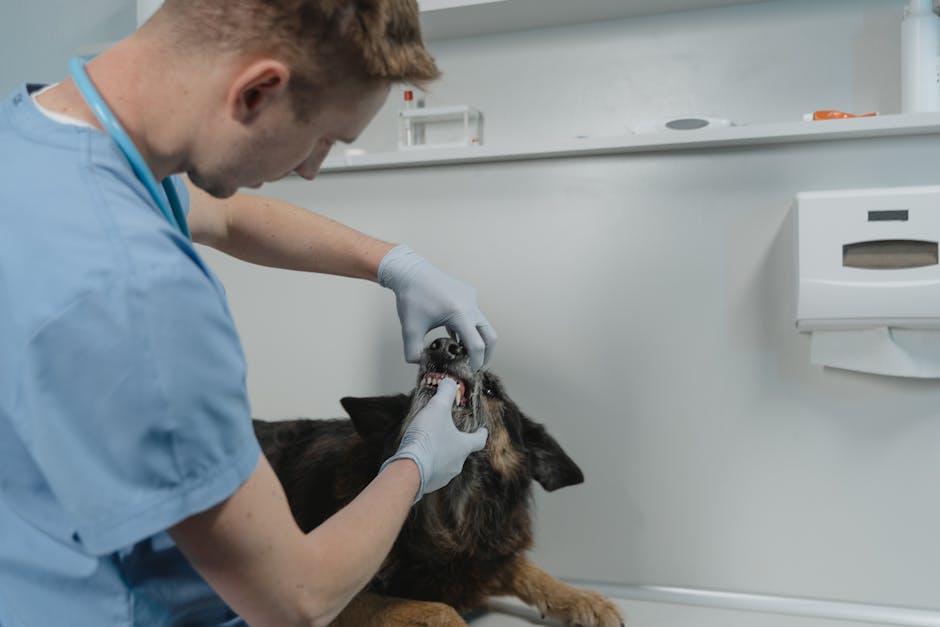
Most teething goes perfectly fine without any vet visits beyond the regular puppy checkups. But it’s worth taking a quick peek inside your puppy’s mouth every week or so during the four-to-seven-month window. You’ll catch problems early, and your puppy gets used to having their mouth handled — which makes dental care much easier for life.
How Teething Affects Potty Training and Behavior
Here’s something that doesn’t get talked about nearly enough: teething can cause potty training regression. I’ve seen this with my own dogs and heard it from dozens of other owners, and it catches people completely off guard.
When puppies are teething, they’re stressed and uncomfortable. Stress affects bladder control — same as it does in human toddlers. A puppy who was reliably going outside might suddenly start having accidents indoors again around four to five months. It’s not defiance. It’s discomfort.
Other behavioral changes during heavy teething:
- Increased nipping and mouthing. Your puppy isn’t being aggressive. Their mouth hurts and chewing provides relief. Redirect to appropriate chew toys — every single time.
- Restlessness and whining. Especially at night. Finn woke us up multiple times during his worst teething week. A frozen Kong before bed helped.
- Decreased appetite. Hard kibble hurts sore gums. Try softening food with warm water or switching to wet food temporarily. Rosie barely ate for three days during her worst stretch — switching to soaked kibble fixed it immediately.
- Ear rubbing and head shaking. The nerves in the jaw and ears are connected. Some puppies rub their ears or shake their heads during teething even though their ears are perfectly fine.
The most important thing: don’t punish a teething puppy for regression. They’re not choosing to misbehave. Stay consistent with training, provide appropriate chew outlets, and ride it out. The teething phase ends. The habits you build during it don’t.
Frequently Asked Questions
When do puppies lose baby teeth?
Puppies typically start losing baby teeth around 12 to 16 weeks (3 to 4 months) old. The incisors go first, followed by premolars and canines. Most puppies have lost all 28 baby teeth by six to seven months of age. You might not find many — puppies swallow most of their baby teeth, which is perfectly normal and safe.
What should I do about puppy double teeth?
If you see two teeth in one spot — a baby tooth sitting right next to an adult tooth — monitor it for a week or two. Sometimes the baby tooth is just a bit slow to fall out. But if the adult tooth is fully erupted and the baby tooth is still solidly in place, talk to your vet about extraction. Retained baby teeth can cause the adult teeth to grow in crooked and create pockets where plaque builds up. Many vets will extract retained teeth during the spay or neuter procedure.
Do all puppies go through a heavy chewing phase?
Yes. Every single one. Some breeds are worse than others — Labradors, Golden Retrievers, and other retrieving breeds tend to be especially mouthy. But every puppy needs to chew during teething. It’s not optional for them. The key is giving them things they’re allowed to chew so they leave your furniture alone. Rotate through several different appropriate toys so they don’t get bored with any single one.
Can teething cause diarrhea in puppies?
Mild digestive changes can happen during teething, partly from swallowing baby teeth and excess drool, and partly from stress. However, significant diarrhea lasting more than a day or two isn’t a normal teething symptom. If your puppy has persistent diarrhea during the teething months, check with your vet — it could be a dietary issue, parasites, or something unrelated to teething.
How can I tell if my puppy’s teething pain is serious?
Normal teething looks like: mild gum redness, occasional blood spots on toys, increased chewing, slight fussiness with food. Serious signs include facial swelling, refusal to eat for over 24 hours, active bleeding that doesn’t stop, extremely foul breath, or visibly broken teeth. When in doubt, a quick vet check gives you peace of mind and catches real problems early.
Teething is a messy, frustrating, totally normal part of puppyhood. Knowing the puppy teething timeline chart — when each type of tooth comes and goes — takes away most of the worry. Stock your freezer with washcloths and puppy Kongs, check your pup’s mouth weekly, and give yourself permission to be annoyed when they chew through yet another pair of slippers. It passes. And then you’ve got a beautiful set of 42 adult teeth that just need regular brushing and the occasional vet dental check to stay healthy for life.
Featured Image Source: Pexels