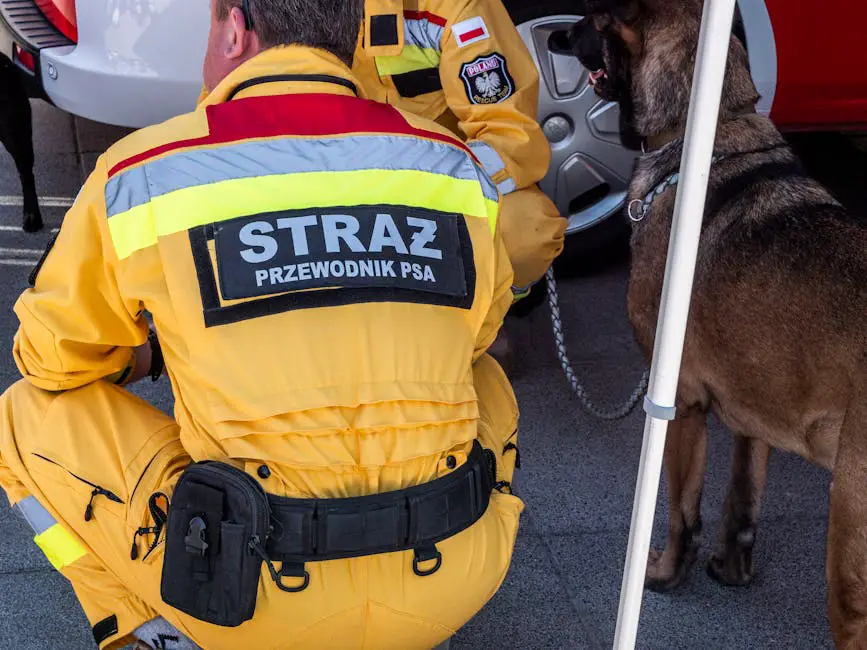

I’ll never forget watching a German Shepherd named Koda work a rubble pile during a training exercise in Colorado. The handler barely gave a command — just a subtle hand gesture — and that dog was gone. Nose down, tail up, scrambling over concrete slabs like gravity was optional. Fifteen minutes later, Koda alerted on a volunteer buried under two feet of debris. The handler’s face said everything. Pride, sure. But mostly trust.
That moment crystallized something I’d been thinking about for years: search and rescue dog training isn’t about teaching tricks — it’s about building a partnership so deep that a dog will work through exhaustion, fear, and chaos because they believe in their person. It’s one of the most demanding things you can ask of a dog. And honestly? Most dogs can’t do it.
But the ones who can? They save lives. Real ones. And the training journey to get there is equal parts inspiring and brutal.
Not Every Dog Has What It Takes
Let’s get this out of the way early. I love all dogs. You know that. But I’m not going to sugarcoat this — the vast majority of dogs aren’t cut out for search and rescue (SAR) work. It’s not about intelligence alone, though that matters. It’s about drive.
SAR dogs need what trainers call “high prey drive” combined with “high hunt drive.” In plain terms, your dog needs to be absolutely obsessed with finding things. Not interested. Not willing. Obsessed. The kind of dog who won’t stop looking for a hidden toy even after 30 minutes. The dog who makes you tired just watching them.
Breeds that consistently excel in SAR:
- German Shepherds — the gold standard, versatile across all SAR disciplines
- Belgian Malinois — intense, fast, tireless (almost too much dog for some handlers)
- Labrador Retrievers — outstanding nose work, great temperament for disaster sites
- Border Collies — brilliant but can be noise-sensitive, which limits some deployments
- Bloodhounds — unmatched trailing ability, 300 million scent receptors vs. a human’s 6 million
- Golden Retrievers — people-oriented drive that translates perfectly to finding victims
Mixed breeds absolutely can work SAR. I’ve seen a Lab-Poodle cross that was one of the best air-scent dogs in her unit. But statistically, you’re stacking odds in your favor with proven working lines from the breeds above.
Here’s the thing nobody tells you upfront: the dog is the easy part. The handler commitment is where most people wash out.
The Handler’s Reality Check
You want to train a search and rescue dog? Clear your calendar. For the next 18 months to 3 years.
I’m not exaggerating. Most SAR teams require handlers to commit to weekly training sessions (often full weekend days), plus additional solo training several times per week. You’ll need to pass background checks, get wilderness first aid certified, maintain physical fitness, and — this is the kicker — do all of it as a volunteer. The overwhelming majority of SAR dog handlers in the United States are unpaid.
Let me break down what a typical training timeline looks like:
| Phase | Duration | Focus |
|---|---|---|
| Foundation | Months 1-6 | Drive building, basic obedience, socialization to strange environments |
| Skill Building | Months 6-12 | Scent discrimination, indication training, handler navigation skills |
| Advanced Training | Months 12-18 | Complex scenarios, longer searches, multi-dog coordination |
| Certification | Month 18-24+ | Testing through FEMA, NASAR, or state-level organizations |
| Maintenance | Ongoing | Weekly training to keep skills sharp for the dog’s working life |
And that’s if everything goes smoothly. I know handlers who spent three years getting certified because their first dog washed out and they had to start over with a new puppy.
The financial commitment is real too. Between training equipment, travel to training sites, veterinary care for a hard-working dog, and gear, expect to spend $5,000-$15,000 over the training period. Some handlers spend more.
How SAR Dogs Actually Learn to Find People
This is the part that fascinates me. The science behind scent work is genuinely incredible.
Every human sheds about 40,000 skin cells per minute. Those cells carry bacteria that produce a unique scent signature — basically your personal smell fingerprint. SAR dogs learn to detect this “scent cone” that drifts from a person’s location based on wind, temperature, and terrain.
There are two primary SAR disciplines:
Air scent dogs work off-lead, ranging ahead of their handler to catch human scent carried on air currents. They don’t need a scent article from the missing person — they’re trained to find any human scent in a given area. Think of them as living, breathing scent detectors sweeping a search zone.
Trailing dogs work on a long lead, following the specific scent trail left by one individual. They need a scent article — a piece of clothing, a pillowcase — from the missing person. Bloodhounds dominate this category for good reason. Their wrinkled faces literally funnel scent toward their nose.
Training starts simpler than you’d think. In the earliest stages, it’s basically hide-and-seek. A helper hides a short distance away while the handler holds the dog. The dog sees where the person goes. They’re released. They find the person. Massive party. Treats, toys, praise — the dog learns that finding humans is the best game in the world.
Then it gets progressively harder. The hides get longer. The helper goes out of sight. The distance increases. Distractions get added — other people, other animals, loud noises. Eventually the dog is searching acres of wilderness or collapsed structures for someone they’ve never met.
The indication — how the dog tells you they’ve found someone — varies by team. Some dogs bark. Some sit. Some do a “refind,” running back to the handler and then leading them to the victim. Whatever the method, it has to be bombproof reliable. Lives depend on that alert being accurate.
The Different Types of Search and Rescue Work
Not all SAR is the same, and different deployments demand different training.
Wilderness Search
The most common type. Dogs search large outdoor areas — forests, mountains, desert terrain. Air scent dogs excel here because they can cover huge swaths of ground. A single well-trained SAR dog can search an area that would take 20-30 human searchers to cover on foot. That’s not an exaggeration — FEMA’s own documentation supports those numbers.
Disaster/Urban Search
This is the footage you see on the news after earthquakes or building collapses. Dogs need to navigate unstable rubble, ignore extreme noise, and work in environments that would terrify most pets. FEMA certifies disaster dogs at two levels, and the testing is intense — dogs work rubble piles for 20 minutes straight in a scenario they’ve never seen before.
Water Search
Yes, dogs can find drowning victims. Cadaver dogs trained in water search work from boats, detecting human scent that rises through the water column to the surface. It sounds impossible but I’ve watched it work. A dog will change behavior dramatically when they hit the scent — pacing, whining, trying to get into the water at a specific point.
Avalanche Search
Time-critical and high-stress. Avalanche dogs need to pinpoint buried victims through several feet of snow. In Switzerland, the Swiss Alpine Club has used avalanche dogs since the 1930s, and they remain faster than any technological alternative for initial searches.
What Washes Dogs Out
Here’s the honest truth that SAR teams don’t always advertise: roughly 50% of dogs that start SAR training never certify. Some estimates put it higher.
Dogs wash out for several reasons:
Fear or anxiety. A dog that startles at loud noises, won’t walk on unstable surfaces, or shuts down in new environments isn’t going to work a disaster site. Some of this can be trained through, but if the underlying temperament isn’t solid, you’re fighting genetics.
Not enough drive. The dog who searches enthusiastically for 10 minutes but gives up at 15? That’s a pet, not a SAR dog. Working dogs need to sustain focus for 30-60 minutes of active searching, take a short break, and go again.
Health issues. SAR is physically brutal. Hip dysplasia, cruciate ligament injuries, chronic joint problems — these end careers. This is why reputable SAR handlers are obsessive about health testing before starting a prospect. OFA hips, elbows, cardiac clearances. Don’t skip this.
Handler problems. Sometimes it’s not the dog. Handlers who can’t read their dog’s body language, who get frustrated too easily, or who simply can’t commit the time — they’re the weak link. Good trainers will tell you straight.
I talked to a handler whose Belgian Malinois washed out not because of ability but because the dog was too handler-focused. She wouldn’t range far enough from her person to effectively search. Heartbreaking, but that dog became an incredible pet and therapy dog instead. Not every failure is a tragedy.
Getting Started — Practical Steps
So you’ve read all of this and you’re still interested. Good. Here’s what to actually do.
Step 1: Find your local SAR team. Google “[your county] search and rescue” or check the National Association for Search and Rescue (NASAR) website. Most teams welcome observers at training sessions before you commit.
Step 2: Attend training as an observer first. Don’t show up with a puppy on day one. Watch. Ask questions. See if this is really your thing. The people who succeed in search and rescue dog training are the ones who fell in love with the mission before they picked their dog.
Step 3: Choose your dog carefully. If you’re buying a puppy for SAR, talk to breeders who produce working-line dogs. Ask about the parents’ drive, temperament, and health clearances. Many SAR handlers get their dogs at 8-12 weeks and start foundation training immediately.
Step 4: Commit to the process. Your first year will be mostly foundation work. It’s not glamorous. You’ll spend hours in a field doing basic scent games. But that foundation is everything.
Step 5: Get your own training up. Wilderness first aid, land navigation with map and compass (not just GPS), ICS-100 and ICS-200 (incident command system courses — they’re free online through FEMA). You need to be as prepared as your dog.
One more thing: your dog needs to be a solid citizen first. Basic obedience, reliable recall, comfortable around strangers and other dogs. A SAR dog who can find a missing person but bites a bystander isn’t deployable. Period.
The Emotional Weight Nobody Talks About
I’d be doing you a disservice if I didn’t mention this.
SAR work involves finding people who are lost, hurt, and sometimes dead. Cadaver work — searching for human remains — is a distinct discipline, and it takes a toll on handlers. Dogs seem less affected by the emotional weight, but handlers carry those missions home.
The SAR community is tight-knit and supportive, and most teams have peer support systems. But go in with your eyes open. The training is demanding. The callouts come at 2 AM on a Tuesday. The outcomes aren’t always happy.
But when they are? When your dog finds a lost child or an elderly hiker with dementia who wandered away from a care facility? There’s nothing like it. Nothing.
Frequently Asked Questions
How old should a dog be to start SAR training?
Foundation work can begin as early as 8 weeks — that’s just confidence building, socialization, and basic scent games. Formal SAR training with a team typically starts between 6-12 months. Most dogs certify between 18 months and 3 years old. Starting with an older dog (over 3) is possible but harder because you’ve missed critical socialization windows.
Can my pet dog become a SAR dog?
Maybe. If your dog has exceptional drive, sound temperament, good health, and isn’t over 2-3 years old, it’s worth having a SAR trainer evaluate them. But be honest with yourself — most pet dogs don’t have the sustained working drive required. There’s no shame in that. Your dog can still be awesome at nose work classes or tracking for fun.
How much does it cost to train a search and rescue dog?
Expect $5,000-$15,000 over the full training period (18 months to 3 years), covering equipment, travel, veterinary care, and training supplies. The training itself is usually provided free through volunteer SAR teams. The big expense nobody budgets for? Gas money driving to training sites, which can be 1-2 hours away.
Do SAR dogs live normal lives when they’re not working?
Absolutely. Most SAR dogs live as family pets — sleeping on couches, stealing socks, begging for dinner scraps. The work/life switch is something handlers actively maintain. The dog learns that the search vest means it’s go time. Vest off means they’re just a dog again. It’s honestly one of the most charming things about these animals.
What certifications do SAR dogs need?
It depends on your region and deployment type. FEMA certification is the gold standard for disaster work (two levels). For wilderness SAR, certifications vary by state — many teams use NASAR standards or state-specific testing. Most certifications require annual recertification to ensure the dog’s skills haven’t degraded.
Worth Every Minute
Search and rescue dog training is one of the hardest, most time-consuming, most rewarding things a dog person can do. It’ll test your patience, your fitness, and your relationship with your dog in ways you can’t predict.
But if you’ve got the right dog and the drive to match — and I mean your drive, not just the dog’s — there’s a community out there waiting for you. Missing people need finding. And a well-trained dog is still the best tool we have for doing it.
Featured Image Source: Pexels