
How to Stop a Dog from Pulling on the Leash: Complete Training Guide
If your daily walks feel more like a tug-of-war championship than a pleasant stroll, you’re not alone. Leash pulling is the single most common complaint I hear from dog owners, and after two decades of working with thousands of dogs, I can tell you this with absolute certainty: every dog can learn to walk politely on a leash. It takes patience, consistency, and the right approach — but it’s entirely within your reach.
This guide breaks down exactly why your dog pulls, what equipment actually helps (and what makes things worse), and the step-by-step training methods that produce lasting results. Whether you’ve got a stubborn adolescent Labrador or a reactive rescue who lunges at every squirrel, you’ll find a strategy here that works.
Why Dogs Pull on the Leash
Before you can fix leash pulling, you need to understand why your dog does it. Pulling isn’t defiance or dominance — it’s driven by three powerful forces working together.
Natural Instinct and Exploration Drive
Dogs experience the world primarily through their noses, and a walk is an explosion of fascinating scents. Your dog’s nose contains up to 300 million olfactory receptors compared to your mere 6 million. Every fire hydrant, patch of grass, and street corner tells a rich story. When your dog pulls forward, they’re following their biological imperative to investigate their environment. They’re not trying to be difficult — they’re being a dog.
Excitement and Anticipation
The moment you pick up the leash, your dog’s arousal level skyrockets. They associate the leash with everything wonderful: new smells, other dogs, open spaces, adventure. That surge of excitement translates directly into forward momentum. A dog in a heightened emotional state physically cannot walk slowly — their body is flooded with adrenaline telling them to go, go, go.
Accidental Reinforcement
Here’s the uncomfortable truth: you’ve been training your dog to pull. Every single time your dog pulls and you follow, they learn that pulling works. They want to reach that tree? They pull, you move forward, they reach the tree. Reward delivered. This cycle repeats hundreds of times per walk, thousands of times per month. You’ve inadvertently created a deeply ingrained habit with an incredibly strong reinforcement history.
The Equipment You Need
The right equipment won’t train your dog for you, but the wrong equipment can make training significantly harder. Here’s an honest comparison of your options.
| Equipment | How It Works | Pros | Cons | Best For |
|---|---|---|---|---|
| Front-Clip Harness | Leash attaches at the chest; pulling causes the dog to turn toward you | Redirects pulling naturally; no pain or discomfort; easy to fit | Can cause chafing with poor fit; some dogs learn to pull sideways | Most dogs; best all-around training tool |
| Back-Clip Harness | Leash attaches between the shoulder blades | Comfortable; good for small breeds; no neck pressure | Actually encourages pulling (opposition reflex); no steering benefit | Small dogs; dogs with trachea issues; not for pull training |
| Flat Collar | Standard collar around the neck | Simple; lightweight; holds ID tags | Pressure on throat and trachea; can cause injury in strong pullers | Dogs who already walk well; ID purposes |
| Head Halter | Loops around the muzzle; controls the head direction | Excellent control of large, strong dogs; gentle steering | Requires conditioning period; dogs often resist initially; can cause neck injury if dog lunges | Very large, strong pullers; when you need immediate management |
| Martingale Collar | Limited-slip design; tightens slightly to prevent escape | Prevents backing out; gentler than choke chains | Minimal pull-reduction benefit; still puts pressure on the neck | Narrow-headed breeds (Greyhounds, Whippets); escape artists |
My recommendation: Start with a well-fitted front-clip harness and a standard 6-foot leash. Avoid retractable leashes entirely — they teach your dog that pulling extends their range, which is the exact opposite of what you want.
The Foundation Technique: Stop-and-Wait Method
This is the bedrock of all loose-leash walking. Master this before layering on other techniques.
- Begin walking at a normal pace. Hold the leash with a relaxed arm. You want a visible “J” shape of slack in the leash between you and your dog.
- The instant the leash goes tight, stop completely. Don’t pull back, don’t yank, don’t say anything. Just freeze. Become a tree.
- Wait for your dog to create slack. They might look back at you, sit down, take a step backward, or turn toward you. The moment there’s any slack in the leash, mark it — say “yes” or click your clicker.
- Resume walking immediately. Moving forward is the reward. Your dog learns: slack leash = we walk; tight leash = everything stops.
- Repeat. Repeat. Repeat. In the first few sessions, you might stop every two or three steps. That’s completely normal. You may only cover half a block in 20 minutes. That’s fine — this is training time, not exercise time.
Critical rule: You must be 100% consistent. If you stop for pulling sometimes but not others, you’re teaching your dog to gamble — and dogs are excellent gamblers. One inconsistent response can undo ten correct ones.
5 Proven Training Methods
1. Penalty Yards
When your dog pulls forward, don’t just stop — walk backward several steps, guiding your dog back with you. This teaches them that pulling doesn’t just pause progress, it actually costs them ground. The penalty is losing distance toward whatever they wanted to reach. Once your dog is back beside you with a loose leash, walk forward again. This method works exceptionally well for goal-oriented dogs who are pulling toward something specific.
2. Direction Changes
Without warning, turn and walk in the opposite direction. Don’t yank your dog — just turn and walk confidently. Your dog will hit the end of the leash and have to scramble to catch up. When they reach your side, praise warmly and continue. After several repetitions, start turning before the leash goes tight. Your dog begins to watch you constantly, because they never know when you might change course. This builds the habit of checking in with you, which is the foundation of attentive walking.
3. Reward Zone Training
Define a “reward zone” — the area beside your leg where you want your dog to walk. Every time your dog is in that zone with a loose leash, deliver treats. In the beginning, reward every few steps. Gradually increase the distance between treats as your dog starts choosing to stay in the zone. Use high-value treats for this — small pieces of chicken, cheese, or freeze-dried liver work well. You’re competing with the entire outside world for your dog’s attention, so your rewards need to be worth it.
4. Attention Training
Teach your dog that making eye contact with you on walks is incredibly rewarding. Start in a low-distraction environment. Say your dog’s name once. The moment they look at you, mark and reward. Practice until your dog offers frequent check-ins without being asked. On walks, periodically reward any voluntary eye contact. A dog who regularly looks at you is a dog who isn’t pulling — they can’t do both simultaneously. This technique transforms walks from a battle into a conversation.
5. Lure and Reward Positioning
Hold a treat in the hand closest to your dog, at their nose level. Let them nibble or follow the treat as you walk together in perfect position. After 5-10 steps, give them the treat and praise enthusiastically. Gradually increase the number of steps before delivering the treat. Over time, fade the lure so your hand is empty but your dog still maintains position, earning rewards from your treat pouch instead. This method is particularly effective for puppies and dogs who are just learning leash skills for the first time.
Common Mistakes That Make Pulling Worse
- Inconsistency: Allowing pulling sometimes (when you’re in a hurry, when it’s raining) teaches your dog that persistence pays off. If you can’t train on a particular walk, manage the situation with a shorter leash rather than letting your dog practice pulling.
- Using a retractable leash: These devices literally reward pulling with more freedom. Every extension reinforces the pull. Switch to a fixed 6-foot leash immediately.
- Yanking or jerking the leash: Harsh corrections create anxiety, erode trust, and often make pulling worse through opposition reflex. Your dog braces against the correction and pulls harder.
- Only training during walks: Practice loose-leash walking in your hallway, your backyard, and your driveway before taking it to the street. Build the skill in easy environments first.
- Moving too fast to high-distraction areas: If your dog can’t walk loosely in your living room, they definitely can’t do it past the dog park. Increase difficulty gradually.
- Skipping exercise before training walks: A dog bursting with pent-up energy cannot learn. Take the edge off with a game of fetch or a training session before expecting calm leash manners.
- Punishing your dog for being a dog: Scolding, leash popping, and frustration damage your relationship without teaching your dog what you actually want. Focus on rewarding the behavior you want to see more of.
Training Timeline and Realistic Expectations
I’m going to be honest with you because I respect your time: leash training takes weeks to months, not days. Here’s what a realistic timeline looks like for most dogs.
- Week 1-2: You’ll spend most of your walk stopping and starting. Progress feels painfully slow. This is the hardest phase — don’t quit. Your dog is learning that the old rules have changed.
- Week 3-4: You’ll notice your dog checking in more frequently. The stops become less frequent. You can walk a full block without stopping. Small victories start stacking up.
- Week 5-8: Loose-leash walking becomes the default in familiar, low-distraction areas. Your dog walks beside you reliably on your regular routes. New environments and high-excitement triggers still cause regression.
- Month 3-6: The skill generalizes to most environments. Your dog can walk past moderate distractions without pulling. You’re using fewer treats and relying more on real-life rewards like sniffing breaks.
- Ongoing: Maintenance is forever. Even well-trained dogs will test boundaries occasionally, especially in new or exciting situations. Brief refresher sessions keep the skill sharp.
Factors that affect your timeline include your dog’s age (adolescent dogs take longer), breed tendencies (high-energy sporting and working breeds need more practice), reinforcement history (a dog who’s been pulling for five years has a stronger habit than a puppy), and — most importantly — your consistency.
Special Situations
Reactive Dogs
If your dog pulls because they’re lunging, barking, or growling at other dogs, people, or vehicles, you’re dealing with reactivity — not just pulling. Standard leash training alone won’t solve this. You need to work at a distance where your dog can notice the trigger without reacting (called “under threshold”) and create positive associations. A qualified trainer experienced in desensitization and counterconditioning protocols is strongly recommended for reactive dogs.
High-Distraction Environments
Parks, pet stores, and busy streets are advanced-level environments. Don’t train there until your dog can walk loosely in quiet areas. When you do move to harder environments, temporarily increase your reward rate and decrease your expectations. Use a “sniff break” system: walk politely for 30 seconds, then release your dog to sniff freely for 15 seconds. This teaches them that patience leads to the thing they want most.
Walking Multiple Dogs
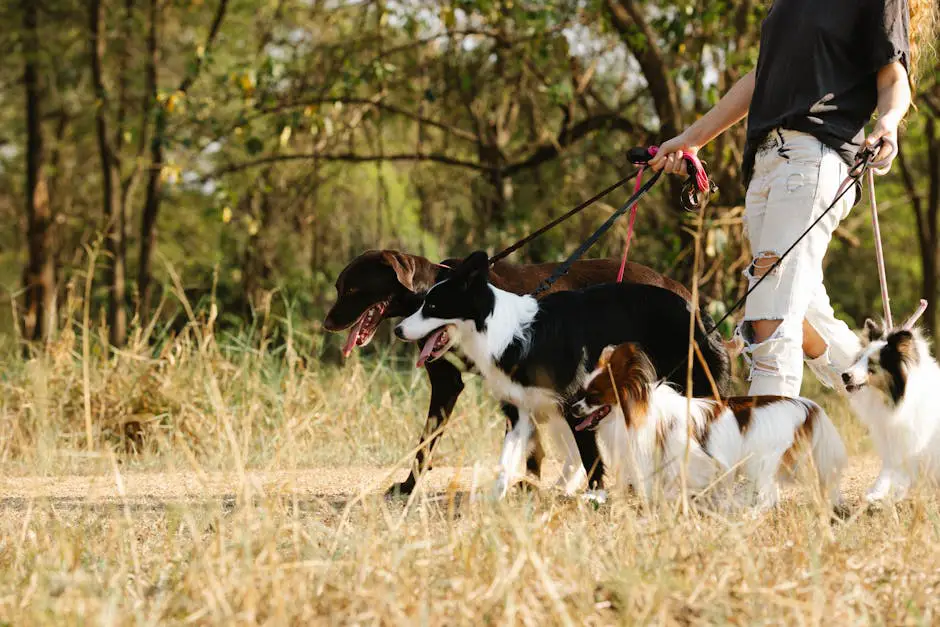
Train each dog separately first. Seriously — trying to train two dogs simultaneously is an exercise in frustration. Once each dog can walk loosely on their own, combine them. Use a coupler only after both dogs are proficient. When walking multiple dogs, consider using different-colored leashes so you can quickly identify which dog is creating tension.
Troubleshooting Guide: When Nothing Seems to Work
If you’ve been consistent for several weeks and aren’t seeing improvement, work through this checklist:
- Are your treats high-value enough? Dry biscuits can’t compete with a squirrel. Upgrade to real meat, cheese, or your dog’s absolute favorite food. Cut treats tiny — pea-sized — so you can deliver hundreds without overfeeding.
- Are you training too long? Training walks should be 10-15 minutes maximum, especially in the beginning. Shorter, more frequent sessions beat one long frustrating walk every time.
- Is your dog getting enough exercise? A border collie who’s been crated all day has energy to burn. Expecting calm leash manners from an under-exercised dog is unrealistic. Address physical and mental exercise needs separately from leash training.
- Is your timing accurate? The mark (your “yes” or click) must happen within one second of the desired behavior. If you’re slow, your dog doesn’t understand what they’re being rewarded for. Practice your timing without your dog first — toss a ball and click the exact moment it hits the ground.
- Are you sending mixed signals? Check your body language. If you’re tense, gripping the leash tightly, or leaning forward, you’re communicating anxiety and urgency to your dog. Relax your shoulders, breathe, and hold the leash with a soft hand.
- Is there a medical issue? Some dogs pull excessively due to anxiety, pain, or sensory processing differences. If your dog’s pulling seems frantic or panicked rather than enthusiastic, consult your veterinarian before continuing behavioral training.
- Are other family members undermining the training? Everyone who walks the dog must follow the same rules. One person allowing pulling will sabotage everyone else’s work. Hold a family meeting and get everyone on the same page.
When to Hire a Professional Trainer
There’s no shame in getting help. Consider working with a professional if:
- Your dog is reactive (lunging, barking, growling at triggers)
- You’ve been consistent for 4-6 weeks with no measurable improvement
- Your dog is so strong that walking them is physically unsafe
- You’re feeling frustrated, defeated, or dreading walks
- Your dog shows signs of anxiety or fear during walks
- You need accountability and structured coaching to stay consistent
Look for a trainer who uses force-free, reward-based methods. Ask about their certifications (CPDT-KA, IAABC, KPA-CTP are reputable credentials). Avoid anyone who recommends prong collars, shock collars, or alpha-based dominance techniques — these methods are outdated, ineffective long-term, and can cause serious behavioral fallout.
A good trainer will observe you and your dog walking together, identify the specific pattern driving your dog’s pulling, and create a customized plan. Most leash-pulling issues can be resolved in 3-6 private sessions plus your daily practice.
Frequently Asked Questions
At what age should I start leash training my puppy?
Start as soon as your puppy comes home, typically around 8-10 weeks. Begin indoors with a lightweight leash and no expectations — just let them drag it around and get comfortable. Short, playful leash sessions of 2-3 minutes work best. Puppies who learn good leash habits early rarely develop serious pulling problems. Even if your dog is already an adult, it’s never too late to start. Older dogs can absolutely learn new walking skills; it just takes a bit more patience to override established habits.
Should I let my dog sniff during walks?
Absolutely — but on your terms. Sniffing is mentally enriching and naturally calming for dogs. Build structured sniff breaks into your walk: walk politely for a stretch, then use a release cue like “go sniff” to let your dog explore freely for 15-30 seconds. Then cue them back to walking position. This way, sniffing becomes a reward for good walking rather than something they have to pull to achieve. A walk with zero sniffing is stressful and unfulfilling for your dog.
My dog only pulls at the start of the walk. Is that normal?
Very normal. The beginning of the walk is when excitement is highest. Try doing 2-3 minutes of basic obedience (sits, downs, hand touches) before you start walking. This gives your dog a chance to burn off that initial burst of arousal and shift into a thinking mindset. You can also practice the stop-and-wait method intensively for the first five minutes, then relax into a more natural walk once your dog settles. Many dogs who pull at the start walk beautifully once they’ve had a few minutes to decompress.
Can I use treats forever, or will my dog become dependent on them?
You won’t need treats forever. Once your dog has a strong habit of loose-leash walking, you’ll gradually fade the treats by rewarding less frequently and substituting real-life rewards — permission to sniff, access to a favorite spot, greeting a friendly dog. Think of treats as training wheels: essential during the learning phase, gradually removed as the skill becomes automatic. Most dogs transition to intermittent rewards within a few months of consistent training. The key is fading treats slowly enough that your dog doesn’t notice the change.
What if my dog walks perfectly for my partner but pulls with me?
Dogs are excellent discriminators. They quickly learn which humans enforce rules and which don’t. If your dog pulls with you but not your partner, observe what your partner does differently. They might stop more consistently, hold the leash differently, or have better timing with rewards. Have your partner watch you walk and give feedback. Sometimes it comes down to something as simple as body language — confident, calm handlers tend to have dogs who walk more calmly. Record yourself walking your dog on video; you might be surprised by habits you didn’t realize you had.
Putting It All Together
Leash pulling is a solvable problem, but it requires you to commit to the process. Start with the right equipment — a front-clip harness and a standard leash. Master the stop-and-wait foundation technique. Layer in the additional methods that suit your dog’s personality and motivation. Be patient with yourself and with your dog. There will be setbacks, frustrating days, and moments where you want to give up.
But here’s what I want you to remember: every stop, every direction change, every rewarded moment of loose-leash walking is building a new habit. Your dog isn’t being stubborn. They’re unlearning a deeply practiced behavior and replacing it with a new one. That takes time, repetition, and unwavering consistency from you.
Start today. Pick one method, grab your best treats, and take a short training walk. Ten focused minutes will teach your dog more than an hour of being dragged around the block. The walks you dream about — relaxed, enjoyable, connected — are absolutely achievable. You and your dog deserve that, and you’re closer to it than you think.
Featured Image Source: Pexels